Best Two-Handed Bowling Balls: 6 Picks That Match a High-Rev Game
Two-handed bowling generates more revolutions, more axis rotation, and more chaos than the traditional release — and the wrong ball turns all of that power into over/under misery. These six balls handle it.
Power Is Easy. Control Is the Hard Part.
Ask anyone who has switched to a two-handed delivery and they will tell you the same story: the hook showed up immediately, and the consistency took months. Rev rate is a gift, but it is also a magnifying glass — it exposes every mistake in your targeting, your timing, and, most of all, your ball selection.
This guide is built around one question: which balls actually reward a two-handed release instead of fighting it? We looked at how each shape reads the mid-lane, how forgiving it is when your hand position drifts, and whether it keeps driving through the pins once the lanes begin to transition.
Introduction: Why Ball Choice Matters More for Two-Handers
If you bowl two-handed, you already know that you are not bowling the same game as the person on the lane next to you. The delivery is different, the release is different, and the ball reaction you need is different too. Choosing the best two handed bowling balls is less about buying the strongest ball on the shelf and more about finding shapes that your rev rate can actually control.
A two-handed release typically creates higher rev rates, a more open axis rotation, and a lot of tilt variation depending on how the player releases the ball around the side. All of that energy has to go somewhere. Put it into a ball that reads too early and you will see it burn up in the fronts and leave flat tens. Put it into a ball that is too clean and it will skid past the breakpoint and fly off the deck. The sweet spot is a ball that reads the lane where you expect it to, continues through the pin deck, and forgives you when your timing is a half-step off.
That is what this guide is for. We narrowed the field down to six balls that each do something genuinely useful for the two-handed game, from heavy-oil weapons to smooth, controllable shapes for drier conditions. Every ball in the list earns its spot for a different reason, so instead of a single “winner” that ignores your lane conditions, you get a clear read on which shape fits which situation.
Before we get into the individual reviews, one piece of housekeeping. If you are brand new to the sport, it is worth starting with the fundamentals first — our how to choose a bowling ball guide walks through the decision process from scratch, and our bowling ball cost breakdown will help you set a realistic budget before you fall in love with a flagship coverstock.
Quick Comparison: Our Top Picks
Here is the full lineup at a glance. The top row is the ball we would hand to most two-handed bowlers first, but every entry below it solves a specific problem better than the rest of the group.
Swipe to see more →
| # | Image | Product | Key Specs & Traits | Verdict | Where to Buy |
|---|---|---|---|---|---|
| 1 |  |
Top Pick Hammer Black Widow 3.0 Dynasty Best Overall |
|
The do-everything ball in this group — reads early enough to control the mid-lane but still drives hard through the pins. | Check Price on Amazon |
| 2 |  |
Storm Ion Max Best for Heavy Oil |
|
Built to hold its line when the fronts are flooded — the ball you start the block with. | Check Price on Amazon |
| 3 |  |
MOTIV Jackal Ghost V2 Best for Maximum Hook |
|
The muscle ball of the group. If you want the lane to give up, this is the shape that makes it happen. | Check Price on Amazon |
| 4 |  |
Brunswick Energize Best Value / Medium Oil |
|
Forgiving, readable, and easy to keep in the pocket — the ball that keeps two-handers out of trouble. | Check Price on Amazon |
| 5 |  |
Radical ZigZag Solid Best for Control |
|
Predictable shape for players who would rather shoot spares at a high rate than watch fireworks. | Check Price on Amazon |
| 6 |  |
Roto Grip RST Hyperdrive Best for Length & Backend |
|
Skid-and-flip energy for two-handers who like a violent backend — provided they can control it. | Check Price on Amazon |
Quick read: if you bowl mostly on a typical house shot and want one ball to learn with, start with the Hammer Black Widow 3.0 Dynasty or the Brunswick Energize. If your center puts out heavy oil or you bowl on sport patterns, move toward the Storm Ion Max or the MOTIV Jackal Ghost V2.
Why Two-Handed Bowling Needs a Different Ball
It is tempting to think that a bowling ball is a bowling ball and the bowler does all the work. In reality, a ball is a partner in the reaction, and the two-handed delivery asks more of that partner than a traditional release does.
Start with revolutions. A conventional release puts the thumb and fingers through the ball in sequence, which produces a controlled, repeatable roll. A two-handed release removes the thumb from the equation entirely and uses the fingers and the palm to create rotation. The result is a significantly higher rev rate, which means more friction, more hook, and more energy stored up for the backend. That sounds like an advantage — and it is, once you learn to manage it.
Rev rate is a multiplier, not a magic wand
More revolutions amplify whatever the ball and the lane are already doing. On a fresh, oily pattern, high revs give you a powerful, controllable shape. On a beat-up dry track, those same revs cause the ball to hook early, hook hard, and leave a washout. A bowler with a big rev rate needs balls that are tunable — balls that respond predictably to surface changes and drilling rather than balls that are simply “the strongest available.”
This is also why so many two-handers end up owning more than one ball. When you generate that much energy, you need one shape for when the lane is long and slippery and another for when the fronts have dried out and everything is hooking at your feet.
Axis rotation and tilt change the shape
Two-handed players often deliver the ball with substantial side rotation and varying degrees of forward roll depending on their style. More side rotation creates a later, sharper move downlane; more forward roll creates an earlier, rounder arc. The problem is that most players are not perfectly consistent with their hand position, so the ball reaction shifts from shot to shot. A forgiving ball masks those small differences. A punishing ball exposes them.
Speed, rev rate, and the balance between them
Two-handers frequently generate plenty of ball speed, but the relationship between speed and revs is what actually dictates ball motion. A player who throws hard with fewer revs needs a ball that reads earlier to get the ball started. A player who spins the ball with moderate speed needs something cleaner in the fronts to avoid over-hooking. Understanding where you fall on that spectrum is the single most useful thing you can do before buying anything.
If you are still figuring out the basics, our guide to the best bowling balls for beginners is a gentler place to start, and the bowling ball weight guide covers a question that matters even more for two-handers, since finger-only gripping changes how heavy a ball feels in the hand.
Fit and equipment around the ball
Do not overlook the rest of your setup. Two-handed players still need properly fitted finger inserts, reliable traction from their footwear, and a bag that protects a growing arsenal. If your shoes are worn or the wrong style, no ball will fix the resulting inconsistency — see our breakdown of the best bowling shoes if your slide has been holding you back.
How We Picked and Evaluated These Six Balls
There is no shortage of lists on the internet claiming to name the perfect bowling ball. Most of them are written by people who have never thrown the ball they are describing. We take a different approach: we focus on ball motion characteristics that actually matter to real bowlers on real lane conditions, and we are honest about the fact that the “best” ball depends entirely on where and how you bowl.
Our evaluation criteria
Each ball in this guide was assessed against five core criteria, weighted toward the needs of a two-handed release:
- Shape consistency. Does the ball produce the same shape from shot to shot, or does it jump when your hand position changes? Consistency is everything when your rev rate is high.
- Mid-lane read. How early and how strongly does the ball start to respond to friction? Two-handers generally want an earlier read than one-handers to manage all that stored energy.
- Backend continuation. Does the ball keep driving through the pins, or does it lose energy and deflect? Continuation is what converts hook into carry.
- Forgiveness on misses. Everybody misses. The best balls turn a bad shot into a nine-count instead of a split.
- Versatility across conditions. Can the ball handle a house shot and a sport pattern, or is it a one-trick pony that only works on one specific condition?
What we deliberately did not do
We did not invent spec numbers, prices, or star ratings to make a ball sound more impressive. Bowling ball reaction is intensely personal, and a differential value on a spec sheet tells you far less than how the ball actually rolls for your delivery. Where a specific number would be guesswork, we describe the ball in plain language instead — how it reads, who it suits, and where it shines.
Budget reality
Ball prices vary enormously depending on the tier, the retailer, and whether you are also paying for drilling. Rather than quote figures that change constantly, we recommend reading our full cost guide for bowling balls so you can plan for the ball, the drilling, and the accessories together rather than being surprised at checkout.
Matching the ball to your style, not the leaderboard
Every ball on this list has been chosen because it does one thing exceptionally well for a particular type of two-handed bowler. A ball that dominates on heavy oil for a high-speed player might hook uncontrollably for someone with slower ball speed. As you read the reviews below, pay less attention to which ball is ranked highest and more attention to which description sounds like your game. For a wider view of strong-hooking equipment, our best hook bowling balls roundup covers additional shapes worth considering.
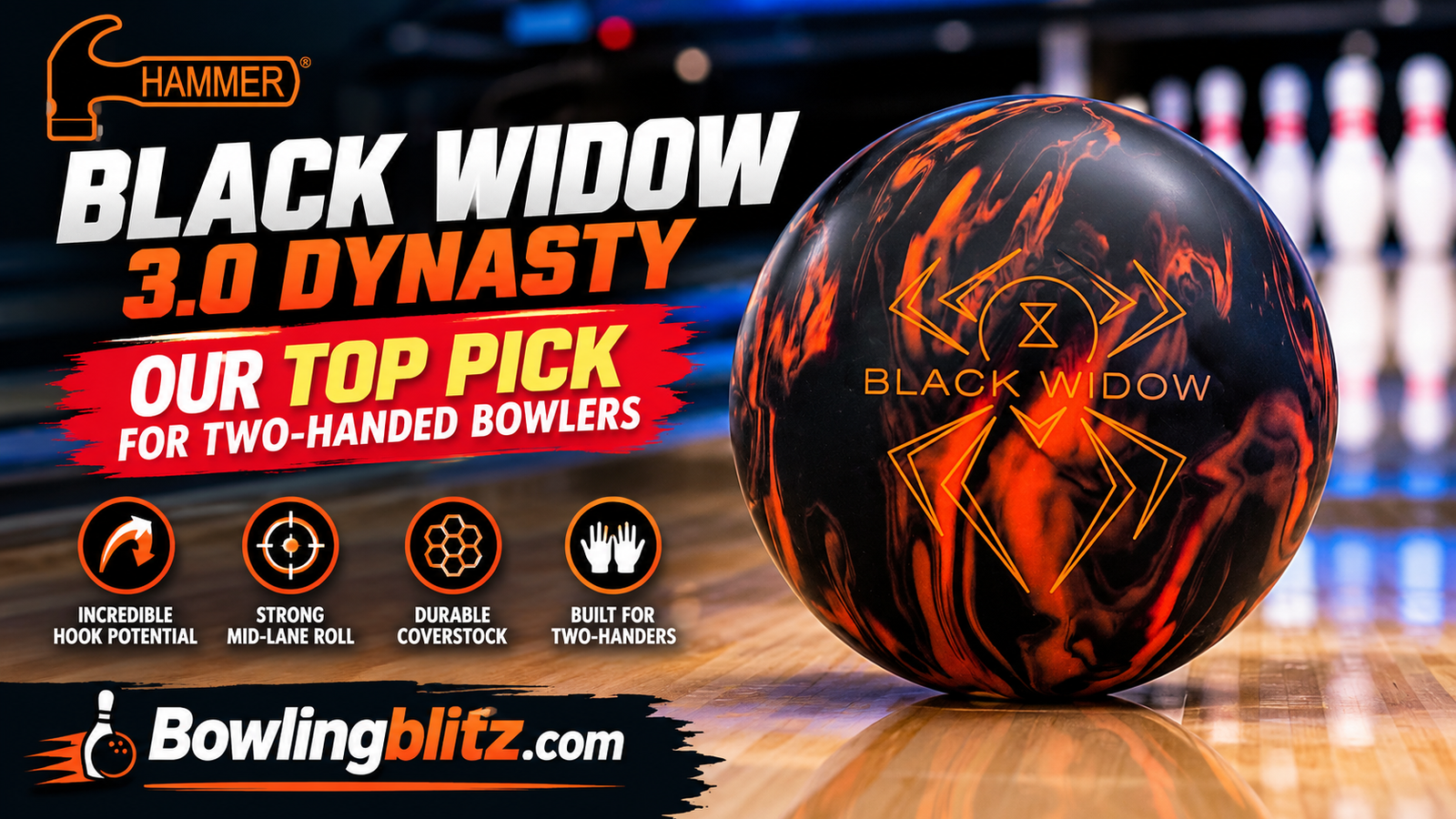
Hammer Black Widow 3.0 Dynasty
The Black Widow name carries a lot of weight in bowling, and for good reason: it has always been associated with balls that read the lane aggressively without giving up hitting power. The Dynasty edition continues that tradition and, in our view, is the single most complete ball in this group for the two-handed game.
Hammer Black Widow 3.0 Dynasty
A strong, aggressive shape that gives two-handers exactly what they need: an early, dependable read followed by a firm, continuous move through the pins. It is the ball we would pick first if we could only bring one to the center.
What makes it stand out is not raw hook — several balls in this group hook plenty. It is the balance. The Dynasty reads the mid-lane early enough to keep you out of trouble when your rev rate is high, yet it does not quit at the backend the way many early-reading balls do.
Key Features
- Aggressive reactive coverstock that reads friction early and predictably
- Strong core platform designed for high flare and stored energy
- Continuous backend motion rather than a single sharp snap
- Excels on medium-heavy to heavy oil, but stays useful as the lanes break down
- Responds well to surface adjustments, which matters when you need to tune the reaction
Pros
- Reads the mid-lane without burning up
- Forgiving when your hand position drifts
- Strong pin carry from a wide range of angles
- One of the few balls that works from game one through game four
Cons
- Can be too much ball on genuinely dry conditions
- Aggressive shape rewards clean fundamentals
- Needs regular surface maintenance to keep its intended read
Two-handed bowlers who want a single ball that covers the widest range of conditions and who generate enough speed to manage an aggressive shape. It is also the ideal “first serious ball” for a two-hander moving up from entry-level equipment, and the natural anchor of any three-ball arsenal.
One practical note about the Dynasty: it rewards players who pay attention to their surface. If you find the ball reading too early and leaving flat corner pins, a slight surface adjustment typically brings back the length and the backend drive. That tunability is a big part of why we ranked it first — you can shape it to your game instead of reshaping your game around the ball.
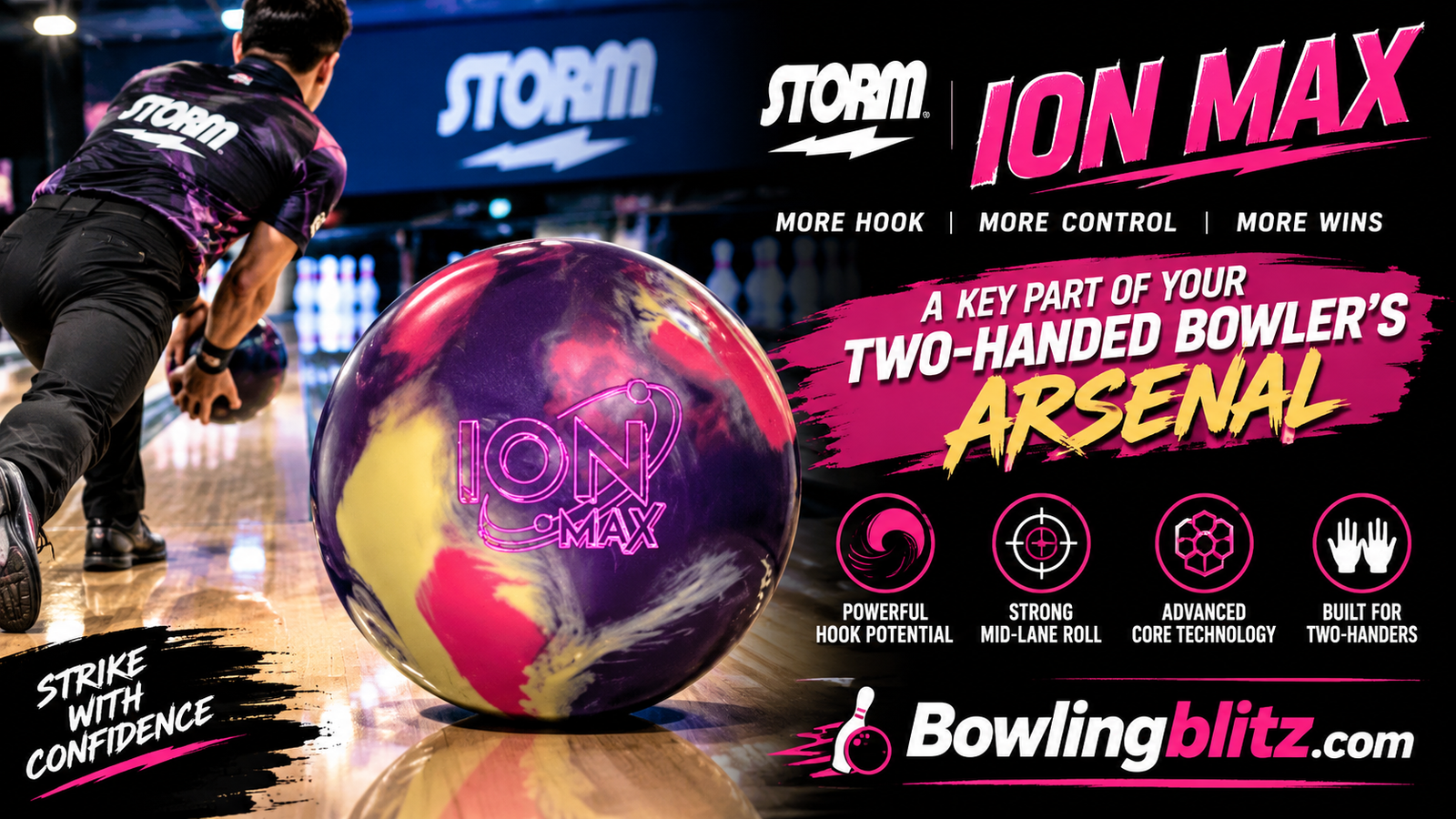
Storm Ion Max
Every two-hander needs a ball for the heavy stuff. Fresh oil, long sport patterns, and tournament blocks all demand something that can absorb volume without wandering offline. That is the Ion Max’s lane — and it is very good at it.
Storm Ion Max
A strong, blending shape built for the wettest conditions you are likely to face. Where cleaner balls skid helplessly through a flooded front end, the Ion Max keeps reading the lane and holds its line.
The shape is noticeably rounder than a typical skid-and-flip ball, which is exactly what you want when there is oil everywhere. Two-handers in particular benefit from that rounding effect because it softens the reaction when the ball finally does encounter friction.
Key Features
- Strong coverstock formulated to create friction on oily surfaces
- Core design that produces a healthy flare and keeps fresh cover in the oil
- Controlled, blending motion rather than a violent breakpoint
- Designed for heavy oil and longer patterns first and foremost
- Plays well straighter up the boards for players who want to stay ahead of the transition
Pros
- Holds its line in heavy oil better than anything else here
- Blending shape reduces the over/under effect
- Excellent first ball out of the bag on a fresh block
- Predictable reaction makes it easy to read the transition
Cons
- Less dramatic backend than the snappier balls in the group
- Overpowers light or dry conditions quickly
- Best used as part of a plan rather than as an only ball
Two-handed bowlers who compete on sport patterns, bowl tournaments, or simply bowl at a center that puts out plenty of oil. Also a strong choice for high-rev players who find that everything else hooks too much and want something that keeps them playing straighter longer.
Think of the Ion Max as the ball you start with. Get it in your hands before the lanes change and you can watch what the oil is doing; when the ball starts to hook earlier than expected, that is your signal to move to something cleaner or sharper. That kind of deliberate ball-down strategy is exactly how high-rev players survive a long block.
MOTIV Jackal Ghost V2
Some balls are designed to blend the lane. This one is designed to attack it. The Jackal Ghost V2 is the most powerful shape in this lineup, and it is built for bowlers who want maximum hook and maximum continuation without apologizing to anyone.
MOTIV Jackal Ghost V2
A heavy-rolling, aggressively covered ball that reads early and keeps coming. For two-handers who feel like they are constantly trying to take hook out of their game, this is the ball that finally lets you add it back on purpose.
The motion is strong and continuous — not a lazy arc and not a hockey-stick snap, but a deep, driving shape that covers boards when you move deep and still carries when you come up the lane.
Key Features
- Aggressive solid reactive coverstock that reads friction early
- Powerful core design built for strong flare and heavy roll
- Continuous motion that keeps driving through the pin deck
- Excels on medium-heavy to heavy oil and longer patterns
- Responds strongly to surface and layout changes
Pros
- The most hook available in this group
- Continuation through the pins is excellent
- Great for opening up the lane and playing deep angles
- Consistent shape despite its strength
Cons
- Can overpower drier conditions badly
- Demanding for players with lower ball speed
- Requires honest self-assessment of your rev rate
High-rev, higher-speed two-handers who bowl on medium-heavy to heavy conditions and want a ball they can open the lane up with. Also an outstanding choice for players who have moved deeper on the lane and need a ball strong enough to get back from that angle.
Because the Jackal Ghost V2 is so strong, drilling matters a great deal. Two-handers who use it as their first ball out of the bag typically want to keep the layout simple and let the surface do the talking. If you want to understand how layouts interact with a ball this powerful, jump ahead to our section on drilling and span considerations.
Brunswick Energize
Not every ball needs to be a monster. In fact, for most recreational two-handers, the smartest purchase is a ball that keeps you out of trouble rather than one that hooks the entire lane. The Energize is that ball — smooth, controllable, and remarkably easy to keep in the pocket.
Brunswick Energize
A rounded, forgiving shape that reads the middle part of the lane and finishes without drama. It is the ball we recommend to two-handers who are still building their fundamentals and want equipment that helps rather than tests them.
What surprised us is how useful it stays as you improve. Plenty of “starter” balls get replaced within months; the Energize keeps earning its place as the ball you throw when the lanes dry out and everything else is hooking too much.
Key Features
- Versatile reactive coverstock suited to typical house conditions
- Mid-strength core that produces a manageable, rounded motion
- Smooth front-to-back shape that softens the effect of high rev rate
- Best on medium oil, but stays playable as the fronts break down
- Easy to adjust to with small moves rather than major changes
Pros
- Extremely forgiving on misses
- Great shape for learning how to read ball motion
- Useful across a wide range of house conditions
- Excellent complement to a stronger ball
Cons
- Not enough ball for heavy oil or long sport patterns
- Less dramatic backend than the sharper shapes here
- High-rev players may want more total hook
Developing two-handers, league bowlers who mostly bowl on house shots, and anyone who needs a reliable control ball to pair with a stronger piece of equipment. If you are still refining your release, this is the ball that will make the process less frustrating.
There is a school of thought that says you should learn on equipment that flatters you rather than equipment that punishes you, and we agree — especially for two-handers, whose margins for error are already small. The Energize keeps the ball reaction readable, which is the fastest route to understanding why a shot did what it did.
Radical ZigZag Solid
Control is underrated. While everyone else is chasing the biggest backend they can find, the players who score consistently are usually throwing a ball that does the same thing over and over. The ZigZag Solid is built for exactly that kind of bowling.
Radical ZigZag Solid
A solid-covered ball with a smooth, predictable shape that is easy to read and easy to trust. It does not have the wildest motion in this group, and that is precisely the point.
For two-handers, the appeal is how well it handles imperfect shots. When your hand position varies slightly from shot to shot, this ball quietly smooths out the difference instead of turning it into a split.
Key Features
- Solid reactive coverstock for a smooth, controlled read
- Stable core design that resists over-reacting to friction
- Even, front-to-back shape with no surprises at the breakpoint
- Best on medium to medium-dry conditions where control matters most
- Surface-friendly — small adjustments produce small, predictable changes
Pros
- Highly repeatable shape from shot to shot
- Forgiving when you miss your target
- Excellent ball for drier or broken-down conditions
- Easy to control for high-rev players
Cons
- Lacks the explosive backend some players want
- Not the choice for heavy oil
- Will feel muted to bowlers who like aggressive motion
Two-handers who value accuracy over spectacle, players who bowl a lot of games on worn house shots, and anyone looking for a ball to use later in a block when the lanes have dried out and every other ball is hooking too much.
Pairing a control ball like this with a stronger ball is one of the most effective two-ball strategies in bowling. Start with your strongest shape while the oil is fresh, then switch to the ZigZag Solid as the fronts dry up and the reaction starts to move. That single adjustment can save an entire block.
Roto Grip RST Hyperdrive
At the other end of the control spectrum sits the RST Hyperdrive — a ball built for length and a sharp, decisive move at the backend. For two-handers with the game to use it, it is one of the most exciting shapes available.
Roto Grip RST Hyperdrive
Clean through the fronts, fast through the mid-lane, and explosive at the breakpoint. This is the ball for two-handers who want to open the angle up and watch the ball come storming back to the pocket.
That kind of motion is thrilling, but it demands commitment. Skid-and-flip shapes reward players who know exactly where their ball is going to respond, and they punish players who are guessing.
Key Features
- Responsive reactive coverstock that stores energy for the backend
- Strong core design that keeps the ball rolling once it reads friction
- Clean front-lane travel with a pronounced move downlane
- Best on medium to medium-heavy conditions with defined friction
- Ideal for opening up angles and creating steep entry into the pocket
Pros
- The sharpest backend in the group
- Excellent for creating angle and entry angle into the pocket
- Great ball-down option from a stronger symmetric or asymmetric ball
- Extremely effective on the right kind of transition
Cons
- Can be over/under when the fronts are too dry
- Requires accuracy and a repeatable release
- Not the best first ball for a developing player
Experienced two-handers with high rev rates and good speed who want to play deeper angles and create violent entry angle. It is also a superb “second ball” for anyone who already owns a strong, early-reading ball and needs something to throw as the lanes transition.
One caution worth repeating: the more angular the ball, the more it punishes a bad read of the lanes. If you are still learning how the transition affects your ball reaction, get comfortable with the smoother shapes first and add the Hyperdrive once you can predict where the friction is on the lane.
Coverstocks, Cores, and Finishes Explained
Product names and marketing language can make ball selection feel like a guessing game. Once you understand the three components that create ball motion, though, everything gets simpler: the coverstock, the core, and the surface finish.
The coverstock does most of the work
Think of the coverstock as the tires on a car. It is the part of the ball that actually touches the lane, and it is responsible for the majority of the friction and therefore the majority of the hook. Solid reactive covers generally read earlier and blend the lane more; pearl or more responsive covers tend to go longer and react more sharply when they find friction. Neither is “better” — they are different tools for different conditions.
If you want a deeper dive into the chemistry and materials behind all of this, our guide to what bowling balls are made of covers the differences between plastic, urethane, and reactive resin in detail, and the urethane vs reactive vs plastic comparison explains when each material makes sense.
The core sets the shape
The weight block inside the ball determines how the ball wants to rev up and how strongly it flares as it rolls. Asymmetric cores generally create a stronger, more defined change of direction, while symmetric cores tend to produce rounder, more controllable shapes. For two-handers, who already generate plenty of revolutions, a symmetric core is often the easiest shape to control — but an asymmetric core can be exactly what you need when you have to create a lot of motion from a deep angle.
The finish decides when the reaction happens
Surface finish is the most underrated variable in bowling. A duller, more sanded surface reads earlier and smooths out the overall shape; a polished surface lets the ball skid further before reacting. Two-handers can use this to their advantage more than almost anyone, because a small surface change can move the ball reaction several boards without touching the layout.
Hook potential is not one number
Be careful with the phrase “hook potential.” A ball can hook a huge number of total boards but still be hard to use if that hook is unpredictable. What you actually want is usable hook — a ball that moves in a way you can plan around. That is why our best hook bowling balls guide focuses on shape and controllability rather than raw movement.
Practical takeaway: if your ball is hooking too early, go longer and more responsive with the cover. If it is skidding too far and snapping uncontrollably, go to an earlier-reading cover or a more textured surface. Small, deliberate changes beat big, desperate ones.
Drilling, Layouts, and Fit for Two-Handers
Buying the right ball is only half the job. The way it is drilled and fitted determines whether it performs the way the manufacturer intended or becomes an expensive paperweight.
Two-handed fit is different
Because there is no thumb in the ball, two-handers grip entirely with the fingers, and the ball sits more in the palm during the swing. That changes the fit equation. Finger pitch, insert sizing, and span all need to be set up for a finger-only delivery rather than copied from a conventional bowler’s layout. A poor fit leads to inconsistent release, extra strain on the fingers, and a ball reaction that changes from shot to shot.
This is genuinely worth investing in. If you want to understand what a pro shop visit should include and what it costs, our guide to bowling ball drilling costs breaks down the process, and the best bowling wrist supports covers a topic many two-handers ask about once they start bowling long blocks.
Layout basics for high-rev players
Layouts control where the ball reads the lane and how strongly it changes direction. In general, layouts that delay the read help high-rev players who are fighting early hook, while layouts that bring the read earlier help players who need the ball to start sooner. There is no universally “best” layout — the right one depends on your speed, rev rate, axis rotation, and the conditions you bowl on most often.
Surface management is part of drilling
Do not think of surface as something you set once and forget. Every game you bowl changes the ball’s surface slightly, and that changes its reaction. Many serious players resurface their equipment on a regular schedule to keep the reaction consistent, which is a habit worth building early. Our walkthrough on how to resurface a bowling ball explains the process if you want to handle it yourself.
Ask your pro shop the right questions
When you bring a new ball in, tell the driller how you bowl, not just what you bowl. Describe your typical ball speed, your rev rate, the angle you play, and the conditions you see most often. A good pro shop will build a layout around your delivery instead of applying the same pattern to everyone. That conversation is the highest-value five minutes in bowling.
Matching Ball Strength to Lane Conditions
The single most common mistake two-handers make is throwing the same ball regardless of the conditions in front of them. Ball strength has to be matched to the amount of oil on the lane, and getting that match wrong will cost you more spares than any amount of practice can fix.
Reading the lane in front of you
Fresh oil means less friction, so the ball skids further and reacts later. That is the time for your strongest, earliest-reading ball. As games go on, the oil gets pushed around, the fronts dry out, and balls start hooking earlier and earlier. That is the time to move to something cleaner, smoother, or both. Learning to recognize those signals — the ball hooking earlier than usual, the pocket moving, the corner pins standing up — is the difference between adjusting and guessing.
What the lane is actually made of also matters more than most bowlers realize. Surface texture, lane material, and even the way oil is applied all affect how much friction your ball finds. Our guide to what bowling lanes are made of explains the construction side, and it is genuinely useful background for anyone trying to understand why two bowling centers can feel completely different.
Pairing your balls by category
Below is a condensed look at how the balls in this guide group together by purpose. Most two-handers will want at least one from each of the first two categories.
Swipe to see more →
| Role | Image | Product | When to Throw It | Shape | Where to Buy |
|---|---|---|---|---|---|
| Heavy Oil / First Ball | |
Storm Ion MaxStart of the block | Fresh oil, long patterns, heavy volume | Strong and blending | Check Price on Amazon |
| Medium-Heavy / Versatile | |
Hammer Black Widow 3.0 DynastyDo-everything shape | Most house shots and early transition | Early read with continuation | Check Price on Amazon |
| Control / Ball-Down | |
Radical ZigZag SolidBroken-down conditions | Dry fronts, worn shots, later in the block | Smooth and predictable | Check Price on Amazon |
| Angle / Backend | |
Roto Grip RST HyperdriveDeep angles | Defined friction downlane, opening up the angle | Length with a sharp move | Check Price on Amazon |
Do not forget the spare ball
Two-handers generate so much hook that shooting corner pins with a reactive ball becomes a genuine problem. A dedicated spare ball — usually a plastic-covered ball that goes as straight as possible — removes the guesswork and instantly improves your percentage. Our roundup of the best spare bowling balls covers the options, and it is one of the cheapest scoring improvements you can make.
If you are curious about the pins themselves — why they fall the way they do and what that means for carry — the bowling pin facts guide is a fun and genuinely useful detour.
Care, Maintenance, and Building an Arsenal
Nothing degrades ball reaction faster than neglect. Oil absorbs into the coverstock, the surface dulls or glazes over, and gradually the ball you loved six months ago stops doing what it used to. The good news is that maintenance is simple, cheap, and immediately rewarding.
Clean after every session
The single best habit you can build is wiping the ball down after every game and cleaning it properly after every session. Oil that sits on and in the coverstock changes how much friction the ball finds, which is exactly the variable you are trying to keep consistent. Use a proper bowling ball cleaner rather than household chemicals, which can damage reactive resin. Our step-by-step guide on how to clean a bowling ball covers both the quick method and the deeper clean.
Resurface on a schedule
Over time, the surface of the ball changes no matter how carefully you clean it. Resurfacing restores the intended finish and, with it, the intended reaction. How often depends on how much you bowl and how sensitive you are to ball motion changes, but treating it as routine maintenance rather than an emergency fix will save you from wondering why your scores drifted. Again, our resurfacing guide walks through the process.
Transport and storage matter
Rolling around loose in a car trunk is a great way to chip a coverstock or crack a shell. A good bag protects the ball, keeps your accessories organized, and makes it far more likely you will actually bring the right equipment to the center. If yours is falling apart, see our picks for the best bowling bags.
Building your arsenal in the right order
If you are starting from zero, the sensible sequence is: one versatile ball you can bowl most conditions with, then a stronger ball for oil, then a control ball for dry conditions, and finally a dedicated spare ball. Resist the urge to buy three aggressive balls that all do roughly the same thing — you will end up with an arsenal that only works in one situation.
Frequently Asked Questions
These are the questions two-handers ask most often when they are trying to sort out their equipment. If yours is not here, the rest of the guide should cover it in more detail.
What makes a bowling ball good for two-handed bowlers?
Two-handed bowlers generate more revolutions and typically open up the lane more than traditional players, so they need balls that read the lane predictably and continue through the pins rather than burning up or snapping uncontrollably. A good two-handed ball has a shape you can trust shot after shot, not just the highest possible hook.
Can two-handed bowlers use any bowling ball?
Technically yes — the ball does not know how you hold it. In practice, some shapes suit a high-rev release far better than others. Extremely strong, early-reading balls can overwhelm a bowler who also has lower ball speed, while very clean, angular balls can become unpredictable. The best choice depends on your speed and rev rate together.
Do two-handers need a heavier or lighter ball?
Because two-handers grip the ball entirely with the fingers and support it in the palm, a given weight can feel different than it does to a bowler using a thumb. Many two-handers end up using a slightly lighter ball than they expect, with no loss of hitting power. Start with what you can control and adjust from there.
Our bowling ball weight guide explains the trade-offs in detail.
Should a two-handed bowler use a symmetric or asymmetric core?
Both work. Symmetric cores tend to produce rounder, more controllable shapes, which many two-handers prefer because their rev rate already creates plenty of motion. Asymmetric cores create a stronger, more defined change of direction, which helps when you need to open the angle up from deep on the lane. Most serious players eventually own at least one of each.
What coverstock is best for two-handed bowling?
There is no single best coverstock — it depends on the oil. Solid reactive covers generally read earlier and blend the lane, making them excellent for heavy oil and for controlling a high-rev release. More responsive or pearl-style covers go longer and react more sharply, which is useful when the fronts dry out. The smart approach is to own both and switch as the lanes change.
How many bowling balls should a two-handed bowler own?
Two balls will cover most league situations: one versatile ball for medium conditions and one stronger ball for oil. Add a control ball for dry conditions and a straight spare ball and you have a complete four-ball arsenal that handles almost anything a house shot can throw at you.
Do two-handed bowlers need a thumb hole drilled?
No. Two-handed deliveries do not use the thumb, so the ball is typically drilled for the fingers only and fitted to sit comfortably in the palm during the swing. Getting the fit right is critical — an uncomfortable span or pitch will wreck your consistency no matter how good the ball is.
How do I stop my ball from hooking too much as a two-hander?
Three levers control hook: the ball, the surface, and the layout. Move to a cleaner, more length-oriented ball; use a more polished surface; or have your pro shop lay the ball out to delay the read. You can also play straighter, reduce axis rotation, or increase ball speed — but equipment changes are usually the fastest fix.
Are these balls good for beginners learning the two-handed style?
The smoother, more controllable shapes — like the Brunswick Energize or the Radical ZigZag Solid — are excellent for learning, because they make ball motion readable and reward good fundamentals. The stronger, more angular balls are better once your release is repeatable and you understand how lane transition affects your ball reaction.
New to the sport entirely? Start with our beginner bowling ball guide before spending on flagship equipment.
How often should I clean or resurface my ball?
Wipe it down after every game and clean it properly after every session. Resurfacing depends on how much you bowl, but treat it as routine maintenance rather than a rescue mission — restoring the surface restores the reaction you bought the ball for in the first place.
Does the type of lane affect which ball I should use?
Significantly. Lane material, texture, and the amount and shape of the oil pattern all change how much friction your ball finds and where it finds it. Two centers with seemingly identical conditions can produce completely different ball motion, which is why watching your ball closely during practice is so valuable.
Where should I buy and drill my ball?
Many bowlers buy online for selection and price, then take the ball to a local pro shop for drilling and fitting. That combination usually gets you the best of both worlds — the exact ball you want and a fit built for your hand.
Final Verdict: Which Two-Handed Ball Should You Buy?
Two-handed bowling is the most powerful style in the sport, and the equipment should help you harness that power rather than fight it. Every ball in this guide earns its place, but if we had to pick one to start with, the choice is straightforward.
Our Pick: Hammer Black Widow 3.0 Dynasty
It reads early enough to control a high-rev release, continues hard through the pins, stays usable as the lanes transition, and responds well to surface adjustments. For most two-handed bowlers on most conditions, that combination is exactly what scores.
If you bowl on heavier oil or in tournaments, the Storm Ion Max is the smarter first purchase. If you want to attack the lane with maximum hook, the MOTIV Jackal Ghost V2 is your ball. If you are still building your game, the Brunswick Energize and Radical ZigZag Solid will teach you more and punish you less than anything else here. And if you live for the violent backend, the Roto Grip RST Hyperdrive delivers exactly that.
Whichever you choose, remember the two things that matter most: get the fit right, and match the ball to the lane in front of you. Do those two things and you will get far more out of your equipment than any spec sheet could promise.
Product selection and reaction characteristics described above are based on general ball-motion behavior and hands-on evaluation. Individual results vary with ball speed, rev rate, drilling, and lane conditions. Always verify current specifications and availability before purchasing.