What Are Bowling Balls Made Of?
A clear, practical look inside the ball: the outer shell, the hidden core, the fillers and dyes, and why each material changes the way your shot behaves on the lane.
Pick up a bowling ball and it feels like one solid, heavy lump of colored plastic. It is not. Underneath that glossy shell sits a carefully shaped weight block, surrounded by filler material, all wrapped in a coverstock engineered to grip a lane coated in oil. Every one of those parts is made from a specific material for a specific reason, and understanding them changes how you shop for a ball, how you care for it, and how you read what it does on the lane.
If you have ever wondered why a cheap plastic ball goes straight while a pricey resin ball hooks hard, the answer lives in the materials. If you have wondered why two balls that look nearly identical behave nothing alike, that answer lives there too. So let us open the ball up, figure out what is really inside, and talk about what it means for your game.
The Short Answer: What Bowling Balls Are Made Of
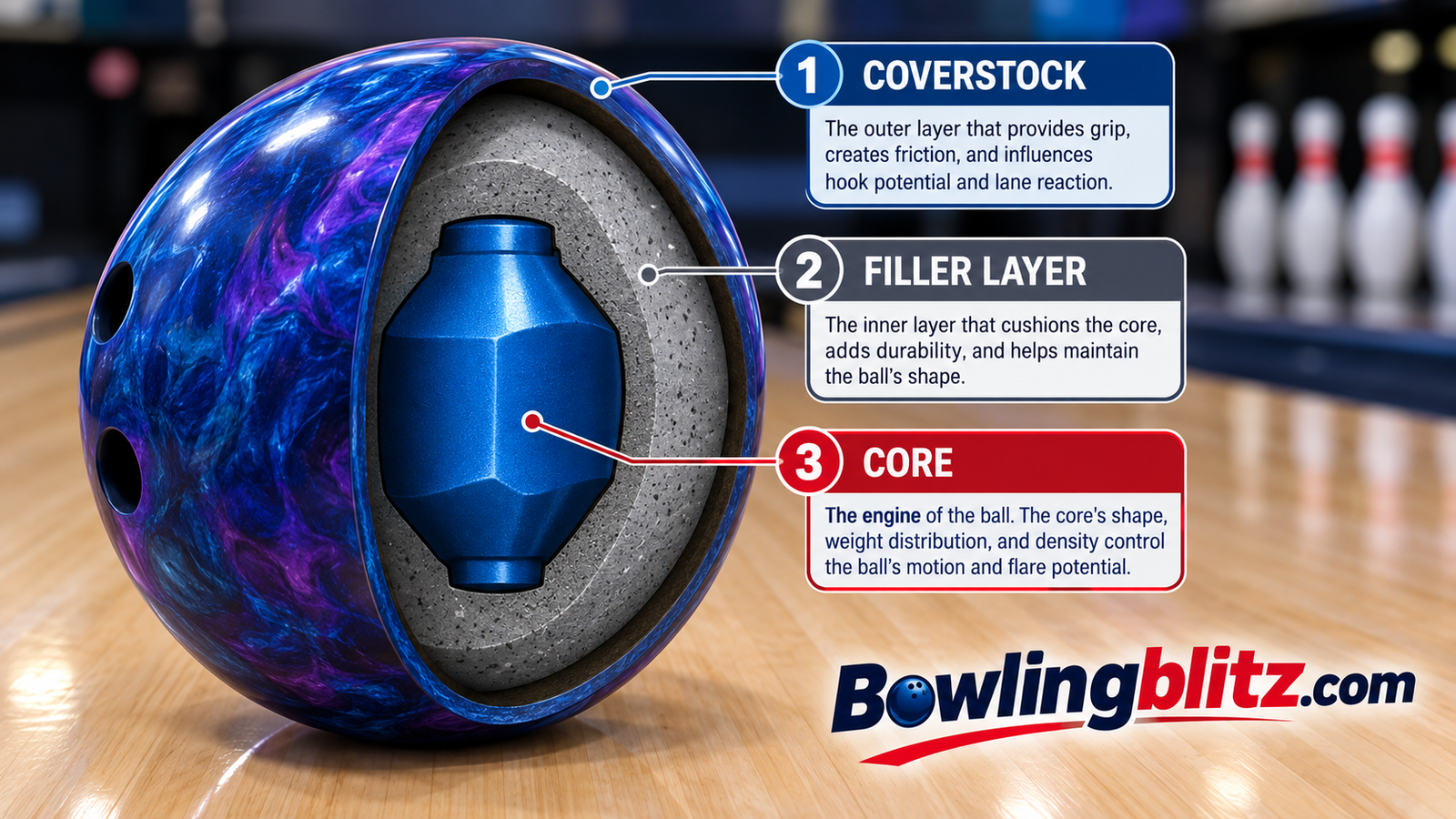
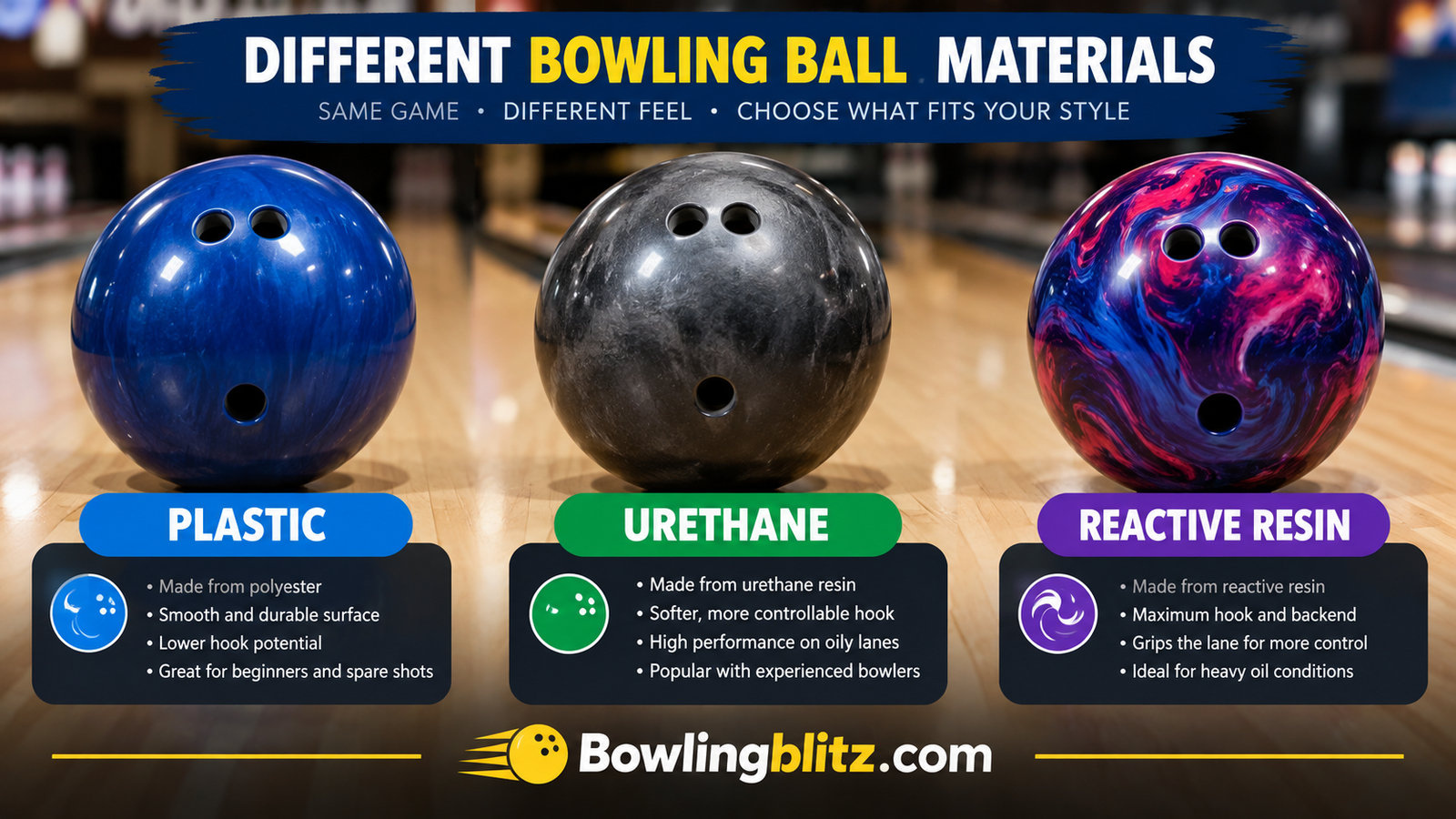
Quick answer: A modern bowling ball is built from three main parts. The outer coverstock is a hard polymer, usually polyester (plastic), urethane, or reactive resin, which is a type of urethane with added chemistry. The inner core is a dense, shaped weight block, often made from mineral and metal-based compounds. Filler material, commonly a lightweight mix with calcium carbonate or similar additives, takes up the space between the two.
That is the headline, and for most casual bowlers it is enough. But the details are where things get interesting. The word “plastic” gets thrown around loosely at the bowling center, yet there are real differences between a polyester house ball and a reactive resin ball designed for a league bowler who throws a big hook. They are both polymers, but they are formulated, cured, and finished in completely different ways.
It also helps to know that the ball is not one uniform material at all. If you sliced a modern performance ball in half, you would see distinct zones with different densities. The core is heavy and compact. The filler is light and bulky. The coverstock is a thin, tough shell that does most of the work when the ball touches the lane. The way these pieces are arranged decides how the ball rotates and when it decides to hook.
Why the material matters more than the look
Color and swirl patterns are what catch your eye on a rack, but they say almost nothing about performance. What matters is how the coverstock reacts with oil and how the core redistributes weight as the ball spins. A glossy, hard coverstock slides through oil and keeps its energy for later. A softer, rougher, more porous coverstock grabs the lane sooner and builds friction. Two balls with matching colors can sit at opposite ends of that spectrum.
If you are brand new to the sport and trying to narrow down a first purchase, our guide to the best bowling balls for beginners walks through what to look for without drowning you in jargon. Keep this article open as a reference for the materials those recommendations are built on.
A quick look at the three layers
- Coverstock: the outer shell that touches the lane and creates friction.
- Core: the dense inner weight block that shapes rotation and hook.
- Filler: the lightweight material that fills the gap between core and shell.
- Finish: the sanded or polished surface texture that tunes how the cover grips.
Anatomy of a Bowling Ball: Coverstock, Core, and Filler
Before diving into each material, it pays to picture the ball as a layered object. Think of it like a peach: a skin on the outside, a pit in the middle, and flesh filling the space between. The comparison is not perfect, but it gets the structure across. Each layer has its own job and its own ingredients.
The coverstock: the part that meets the lane
The coverstock is the outer shell, and it is the only part of the ball that ever touches the lane. Its thickness varies by design, but it is typically only a fraction of the ball’s total radius. Despite being thin, it controls the most important variable in bowling: friction. A coverstock that slides easily through oil will skid longer and hook later. One that bites quickly will read the lane early and curve sooner.
Coverstocks are made from polymers, which are long chains of repeating molecules that can be mixed and cured into a hard, durable solid. The specific polymer, the additives mixed in, and the surface finish applied afterward all combine to set how the cover behaves.
The core: the engine inside
Inside the shell sits the core, also called the weight block. It is a dense piece shaped in a specific geometry. Its job is to hold weight in a precise arrangement so the ball spins in a particular way. When you release the ball with rotation, the core’s shape determines how readily the ball flips from spinning on one axis to another, and that shift creates the downlane motion many bowlers love.
Core design is a surprisingly deep topic, and we will give it its own section later. For now, hold onto this idea: the coverstock decides when the ball wants to grab, and the core decides how it moves once it does.
The filler: the unsung space-holder
Cores are dense, and if they filled the entire ball it would weigh far more than the legal maximum. So manufacturers surround the core with a lightweight filler. Think of filler as the packing material that keeps the core where it belongs, builds out the ball to its required diameter, and keeps the overall weight in check. It does not directly affect hook, but it helps tune how weight is distributed, and it is bonded tightly enough that the ball behaves as one unit.
Where the finger holes fit in
Drilling matters too. When a ball is drilled, material is removed from specific spots, which changes how weight sits in the ball. A good driller works with the internal layout to place the holes so the ball ends up legal and balanced for your hand and style. That is why the same ball can behave slightly differently when drilled for two different bowlers. If you are still working out how heavy a ball you should even be considering, our breakdown on what weight bowling ball you should use is a helpful companion read.
| Layer | Typical Materials | Main Job |
|---|---|---|
| Coverstock | Polyester, urethane, reactive resin, particle additives | Creates friction with the lane and oil |
| Core | Dense mineral and metal-based compounds | Shapes rotation and the motion of the ball |
| Filler | Lightweight mix, often with calcium carbonate | Fills space and balances overall weight |
| Finish | Sanded or polished surface | Tunes how early or late the cover grips |
How Ball Materials Evolved Over Time
Bowling balls did not always look or perform the way they do now. The story of ball materials is really a story of bowlers and engineers pushing each other forward, one innovation at a time. Knowing the arc helps explain why we have so many material categories today and why older balls can still turn up in basements and thrift shops.
From wood to rubber
The earliest balls used in ten-pin style bowling were turned from dense hardwood, with a tropical wood called lignum vitae being a famous choice thanks to its weight and toughness. Wood balls were heavy, prone to cracking, and could not be produced to consistent standards. As the sport grew in the early twentieth century, hard rubber arrived and took over. Rubber balls were more durable and easier to make uniformly, and they helped bowling expand into a mainstream pastime.
The plastic era
Around the middle of the twentieth century, polyester entered the picture. Polyester balls were smooth, hard, and inexpensive, and they resisted wear far better than rubber. They became the standard for house balls and remain so today. Their slick surface does not hook much, which is exactly why they are still loved for spare shooting and for beginners learning a straight, repeatable delivery.
Urethane changes the game
As the century moved along, urethane arrived and gave bowlers something new: a coverstock that actually gripped the lane. Urethane is softer and more porous than polyester, so it absorbs a little oil and creates friction. For the first time, ordinary bowlers could get a smooth, controllable hook, and the way people thought about equipment changed.
The reactive resin revolution
Toward the end of the twentieth century, reactive resin became the next big leap. By modifying the urethane formula with additives that react with the lane’s oil, manufacturers created covers that could grab far more aggressively and still roll smoothly. Reactive resin dominated the performance market almost immediately and has stayed there since. Later came particle-infused covers and hybrid formulas, each pushing the traction envelope in a slightly different direction.
Why history still matters today
Each generation of material did not erase the last. Plastic, urethane, and resin all still exist because each has a job. Understanding that lineage makes the modern shopping experience far less intimidating. You are not choosing between good and bad materials; you are choosing between tools built for different conditions. If you want to pick the right tool for your situation, the walkthrough on how to choose a bowling ball covers that decision from the ground up.
| Era | Dominant Material | Why It Mattered |
|---|---|---|
| Early days | Hardwood (such as lignum vitae) | Dense and available, but inconsistent and fragile |
| Early twentieth century | Hard rubber | Durable, uniform, helped popularize the sport |
| Mid-century | Polyester (plastic) | Affordable and tough; the house ball standard |
| Later twentieth century | Urethane | First cover with real, controllable traction |
| Late twentieth century onward | Reactive resin and particle covers | Big hook potential with smooth, strong motion |
Plastic (Polyester) Coverstocks: The Classic Workhorse
When people say “plastic bowling ball,” they usually mean polyester. It is the oldest of the modern coverstocks and still one of the most useful. If you have ever rented a ball at a bowling alley, there is a very good chance it had a polyester shell.
What polyester is and how it behaves
Polyester is a hard, dense, non-porous polymer. Because it has almost no pores, it does not absorb oil, and its surface stays smooth and slick. That slickness is the whole story. A polyester ball slides through the front part of the lane with very little friction and does not hook much at the back. It travels in a fairly straight line, which is precisely what you want when you are picking up a single pin.
The material is also remarkably tough. It resists scratches, chips, and the wear that comes from years of banging into pins and ball returns. That durability is why bowling centers choose it for rental fleets, and why a well-kept plastic ball can last for decades.
Who should use a plastic ball
Plastic suits two groups especially well. The first is beginners, who benefit from a ball that goes where it is pointed without a lot of variable hook. The second is bowlers of every level who need a dedicated spare ball. A straight, predictable shot makes it much easier to hit single pins at the same angle every time. If you want a deeper look at that second use, our roundup of the best spare bowling balls goes through the options.
Price and availability
Because polyester is simple to make and widely produced, plastic balls are generally the most affordable option at the pro shop or online. They are also the easiest to find, since nearly every manufacturer offers at least one. Curious how a plastic ball compares with a premium resin ball on cost? Our article on how much a bowling ball costs breaks down typical price ranges across materials.
Pros
- Very affordable
- Extremely durable and low maintenance
- Straight, predictable roll
- Ideal for spares and beginners
- Easy to clean
Cons
- Little to no hook potential
- Struggles to carry strikes on many shots
- Not suited to heavier oil patterns
- Limited performance range
A plastic ball will not win you a tournament, but it earns its spot in almost every bowling bag. Think of it as the reliable pickup truck of the sport: nothing flashy, always ready to work.
Urethane Coverstocks: Smooth, Controlled Hook
Urethane sits in the sweet spot between the simplicity of plastic and the aggression of reactive resin. It is a polymer with more flex and more porosity than polyester, which gives it a gentle grip on the lane without the sharp, sudden turn that some resin balls produce.
How urethane works on the lane
A urethane cover has a slightly open surface that absorbs a small amount of oil, so it generates more friction than plastic. But it does not absorb nearly as much as reactive resin does. The result is a ball that reads the lane in a smooth, progressive way. You get a rounded, arcing path instead of a long skid followed by a violent snap.
That smoothness is the defining characteristic. Experienced bowlers often describe a urethane ball as “predictable” and “clean.” It does not overreact to slight changes in release, which makes it forgiving in the right situations.
When urethane shines
Urethane is a favorite on drier lane conditions, where reactive resin can hook too early and too hard. It is also popular as a step up from plastic for developing bowlers who want to learn to hook the ball without being thrown into the deep end. And many serious players keep a urethane ball as a second spare option, particularly for corner pins and tricky leaves where a touch of hook helps.
If you are a newer bowler asking whether to jump straight into resin, you do not have to. Urethane can be a smart middle step that teaches rotation and release without punishing mistakes. Our beginner ball guide covers when a urethane option makes sense.
Care and durability
Because urethane is porous, it absorbs some oil and dirt, and it benefits from regular wiping after play. Left uncared for, it can lose responsiveness over time as the pores fill up. With basic habits, though, a urethane ball holds up well and keeps its predictable character for a long stretch.
Pros
- Smooth, controllable arc
- Great on dry or medium-dry lanes
- Forgiving of small release variations
- Excellent as a spare or backup ball
Cons
- Less raw power than reactive resin
- Can struggle on heavy oil
- Needs regular cleaning to stay consistent
- Less of a “wow” factor on the back end
Reactive Resin Coverstocks: The Modern Performance Standard
Walk into any league night and most of the balls you see will have a reactive resin cover. It is the dominant performance material, and for good reason. Reactive resin is essentially a heavily modified urethane designed to chemically and physically interact with lane oil to create strong, controllable traction.
What makes it “reactive”
The name comes from the way the coverstock behaves in oil. The formula is built with additives that make the surface more porous and more willing to bite into the lane. As the ball rolls through oil, the cover absorbs some of it and creates friction, and the ball picks up grip. This grip is often strong enough to produce a pronounced hook, with the ball arcing sharply toward the pocket as it reaches the dry back part of the lane.
Not all reactive resin balls act the same, however. Manufacturers tune the formula, the surface texture, and the pairing with a given core to produce a wide family of behaviors. Some reactive balls skid long and then turn fast. Others start reading the lane earlier and roll through the pins with a smoother, more continuous arc.
Strengths on the lane
Reactive resin shines when there is oil on the lane, especially medium to heavy patterns. The cover absorbs enough oil to keep the ball from sliding out of control, while the core keeps energy for the pins. The payoff is better entry angle into the pocket, which is the angle at which the ball strikes the headpin. A steeper angle generally means more pin carry and more strikes.
Challenges and trade-offs
That grip comes with a few catches. Reactive balls cost more than plastic or urethane. They also absorb oil, which means the cover can slowly fade as it soaks up lane conditioner and dirt. They respond strongly to how you release the ball, so lower-rotation bowlers may not get the full benefit. And on very dry lanes they can hook too much, too soon. Still, for most bowlers who throw a hook, reactive resin is the right place to land.
Wondering how much more you will pay for one? Our guide to bowling ball costs lays out realistic price tiers, and the breakdown of where to buy bowling balls helps you find a trustworthy seller whether you shop online or at a local pro shop.
Pros
- Strong, versatile hook potential
- Excellent on medium and heavy oil
- Huge range of designs and price points
- Great pin carry when matched well
Cons
- Higher price than plastic or urethane
- Cover wears and absorbs oil over time
- Can hook too much on dry lanes
- Needs more care and occasional resurfacing
Particle, Hybrid, Solid, and Pearl: Reactive Variations Explained
Once you step into the resin world, you quickly meet a few extra labels: solid, pearl, hybrid, and particle. They are not separate materials so much as variations on the reactive theme. Think of them as different recipes using the same basic ingredient family.
Solid reactive
Solid reactive covers are made without pearl additives, and they are typically finished with a duller, more textured surface. That surface is more porous and absorbs oil more readily, so solid balls tend to grab the lane earlier. They excel on medium to heavy oil, where you want the ball to start gaining traction sooner and roll smoothly through the middle of the lane.
Pearl reactive
Pearl covers contain tiny mica or ceramic-like particles that add shine and change how the surface interacts with oil. They usually polish to a glossier finish, which lets them slide farther through the front of the lane before reacting at the back. The result is a sharper, later move. Pearl balls are a common choice for medium to light oil or for bowlers who need more length.
Hybrid reactive
As the name hints, hybrid covers blend traits of solid and pearl chemistry. They aim to deliver a smoother transition between the skid and the hook, often with a reaction somewhere between the two. Hybrids are popular because they handle a wide range of conditions, making them a handy “all-rounder” in a bowler’s arsenal.
Particle coverstocks
Particle balls add microscopic particles into the cover blend that create a rougher microscopic texture on the surface. That roughness bites into the lane more aggressively, especially in heavier oil, helping the ball grab and move through oily conditions. Particle covers can be very strong, but they also demand good ball speed and rotation to use well.
A quick comparison
| Cover Type | Surface Feel | Typical Reaction | Best Lane Conditions |
|---|---|---|---|
| Solid | Dull, textured | Early, smooth, continuous | Medium to heavy oil |
| Pearl | Glossy, polished | Longer skid, sharper back-end move | Light to medium oil |
| Hybrid | Balanced | Blend of length and traction | Wide range, versatile |
| Particle | Rougher, gritty | Strong grip, powerful midlane read | Heavier oil, high-friction shots |
If the number of labels feels overwhelming, you are not alone. Start by deciding what lane conditions you bowl on most, then let those guide which variation makes sense. The article on choosing a bowling ball includes a simple decision path that makes this much less confusing.
Inside the Core: Weight Blocks, Density, and Shape
If the coverstock is the part that grips, the core is the part that steers. Hidden inside every performance ball is a dense, carefully shaped weight block. Its material and geometry are a big reason two balls with similar covers can behave very differently on the lane.
What cores are made from
Cores are formed from dense compounds, often built on mineral and metal-based materials. Manufacturers use heavy ingredients so a lot of mass can be packed into a small volume. This lets the designer shape the core precisely and keep the mass concentrated where it is needed, while lighter filler takes up the rest of the space. Exact recipes are proprietary, and each brand guards its formulas closely, but the principle is always the same: pack in weight, then control its position.
Symmetric versus asymmetric cores
Core shapes fall into two broad families. A symmetric core is shaped the same on both sides of its center, so the ball moves in a clean, predictable way. These are often described as smooth and easy to control. Symmetric balls are a common pick for bowlers who want a steady, readable reaction and for lanes that already provide a lot of friction.
An asymmetric core has a lopsided shape, so the weight is not mirrored from one side to the other. That uneven distribution lets the ball change its spin axis more dramatically as it travels. It tends to produce stronger, more explosive motion on the back end. Asymmetric balls are popular among higher-rev players and those who want maximum angle into the pocket.
RG and differential in plain English
Two numbers you will see in ball specs come straight from the core. The first is radius of gyration, usually shortened to RG. It describes how far from the center the ball’s mass is effectively placed. A lower RG means the ball revs up quickly and starts rotating sooner. A higher RG means the ball resists turning at first, so it tends to skid farther before reacting.
The second is differential. This is the difference between the ball’s highest and lowest RG values. A bigger differential means the ball can transition its spin axis more, creating more potential flare, which is the visible track growth as the ball travels. A smaller differential gives a more controlled, subtle reaction. Think of RG as how early the engine revs, and differential as how big the move can be.
| Core Trait | Low Value Tends To… | High Value Tends To… |
|---|---|---|
| RG | Rev up early, read the lane sooner | Skid longer, save energy for the back end |
| Differential | Roll smoothly with a controlled arc | Flare more and make a bigger move |
| Core Symmetry | Symmetric: steady and predictable | Asymmetric: stronger, more dramatic change |
Why weight blocks matter for your weight choice
Core design also interacts with ball weight. A lighter ball has less material to work with, so manufacturers adjust the core to compensate. This is one reason why a ball in a lower weight can behave a little differently from the same model in a heavier size. When you are comparing options, remember that choosing the right weight is as important as picking the right core. Our walkthrough on what weight bowling ball to use explains how to settle on the right number before you worry about core fine print.
Plastic and urethane balls: simpler cores
Not every ball has a complicated core. Many plastic spare balls use a simple, uniform internal design with little emphasis on flare. That is a deliberate choice, since the goal is a straight, stable roll. If you are shopping for a ball with a straightforward core and no frills, check the best spare bowling balls list.
Fillers, Dyes, and Finishes: The Supporting Cast
Coverstock and core get most of the attention, but a bowling ball also depends on a handful of quieter ingredients. These supporting materials do not make headlines, yet leaving them out would produce a ball that does not work at all.
Filler material
Filler is a lightweight compound poured around the core to fill the interior of the ball. A common ingredient is calcium carbonate, a mineral widely used as a bulking agent in many manufactured products. Filler keeps the ball at its legal diameter without adding unnecessary weight. It also bonds with the core and cover so the three layers behave like a single object. If the filler did not bond properly, the ball would suffer cracks or internal gaps, which is why quality control at this stage is so important.
Colorants and pigments
Those bright swirls and marbled patterns come from pigments mixed into the coverstock. Manufacturers blend dyes and powders into the liquid resin so the color runs through the shell instead of sitting only on the surface. That is why a scratched or sanded ball still shows its color underneath. Some balls also include glow-in-the-dark or UV-reactive additives, which look fun under the black lights in cosmic bowling, though they are mostly there for style rather than performance.
Performance additives
Beyond color, the coverstock recipe can include additives that change how the ball behaves. Pearl pigments alter the surface texture. Particles roughen the micro-surface for extra grip. Other chemical agents are added to tune how porous the cover is and how it handles oil. These ingredients are what separate one reactive ball from another, even when they look similar.
Surface finish: the final adjustment
After the ball is cast and cured, its surface is sanded or polished to a specific finish. A rougher, duller finish creates more friction and reads the lane sooner. A polished, shiny finish reduces friction and lets the ball skid farther. Bowlers and pro shop techs can change the finish later, and some players do so many times to adapt the same ball to different conditions. Think of the finish as a volume dial: the cover chemistry sets the range, and the finish decides where on that range the ball sits.
| Finish Style | Surface | Effect on Ball Motion |
|---|---|---|
| Rough or matte | Dull, textured | More friction, earlier hook |
| Medium | Lightly sanded | Balanced length and grip |
| Polished | Smooth, glossy | Less friction, longer skid, later reaction |
Finish is not permanent. As you bowl, the surface gets worn down, polished by repeated contact, and loaded with oil. Resurfacing restores the original texture and helps the ball perform the way it did when new. A pro shop can do this for a modest fee.
How a Bowling Ball Is Made, Step by Step
Making a modern bowling ball is part chemistry, part precision engineering, and part patience. While each manufacturer has its own proprietary methods, the general process follows the same basic path from raw ingredients to a finished ball in the rack.
Step one: forming the core
The process starts with the core. Dense core materials are mixed and poured into a mold shaped to the designer’s specification, then cured until solid. This stage defines the ball’s internal geometry, which will later determine its RG and differential. Because the shape matters so much, cores are checked carefully to confirm they match the design.
Step two: suspending the core in a mold
Next, the finished core is positioned inside a large spherical mold. It needs to sit in exactly the right spot, since even a small shift would change how the ball behaves. Special supports hold it in place while the next ingredients are added.
Step three: adding the filler and the coverstock
With the core held in position, filler material is introduced around it to build out the ball’s interior. Then the coverstock is poured in as a liquid and fills the outer region of the mold. The pigments, additives, and particles discussed earlier are blended in at this stage. The liquid resin begins to harden as it reacts chemically and sets around the core and filler.
Step four: curing
Curing is the waiting game. The ball stays in its mold under controlled conditions while the resin hardens completely. Rushing this step risks weak spots, bubbles, or uneven hardness, so manufacturers allow enough time for the ball to cure fully. Once it is ready, the ball is removed from the mold.
Step five: shaping and trimming
The newly cured ball is rough around the edges, sometimes literally. Excess material is trimmed away, and the ball is machined to the correct size and shape. The surface is ground until it reaches the desired diameter and roundness.
Step six: finishing the surface
Now the ball receives its factory finish. Depending on the design, it may be sanded with fine abrasives to a specific texture or polished to a high gloss. The finish is chosen to match the intended reaction of the ball model.
Step seven: testing and inspection
Finally, the ball is checked for size, weight, and surface quality. It is also checked against the rules set by bowling’s governing body, which limit things like weight, diameter, and how unevenly weight can be distributed. Balls that pass are packaged and shipped to pro shops and retailers, where a driller will later customize the finger holes for the buyer.
What happens at the pro shop
The ball you buy is not usually ready to throw straight out of the box. It still needs to be drilled to fit your hand. A good driller reads the ball’s layout, measures your span and grip, and bores finger and thumb holes in the right locations. This is the last step in turning a manufactured ball into your ball. If you are still deciding where to shop, our guide to where to buy bowling balls covers both in-person and online routes.
Weight, Size, and Rules: What the Governing Bodies Require
You might assume a manufacturer can make a ball however heavy or large it likes. It cannot. Competitive bowling is governed by organizations that set strict limits on size, weight, and construction. Even if you never bowl a sanctioned league, these specifications shape the balls on the market.
Diameter and weight limits
A standard ten-pin ball is a sphere with a diameter of roughly eight and a half inches. Governing bodies allow only a small tolerance above that, so every legal ball is almost exactly the same size. The maximum weight is sixteen pounds. There is no official minimum, which is why you can find balls as light as six pounds designed for kids and smaller adults.
Notice that size does not change with weight. A six-pound ball and a sixteen-pound ball are essentially the same diameter. The difference comes entirely from the density of what is inside. That is why lighter balls are built with different core and filler arrangements than heavy ones, and why dense core compounds matter so much to the design.
Weight distribution limits
A bowling ball may not be perfectly balanced once it is drilled, but the rules limit how uneven it can be. Under governing-body rules, there are caps on how much extra weight can sit on one side of the ball or on the top. This keeps drilling from creating an unfair advantage and ensures the ball remains predictable.
Hardness and surface rules
Rules also address the hardness of the coverstock, which is measured on a durometer scale. A minimum hardness requirement helps prevent covers from becoming overly soft and sticky, which would produce an unfair level of grip. Surface treatments and additives are also regulated so that balls remain within accepted performance limits.
Rule overview at a glance
| Specification | Typical Requirement | Why It Exists |
|---|---|---|
| Diameter | About 8.5 inches, with very tight tolerance | Keeps every ball the same size |
| Maximum weight | 16 pounds | Safety and fairness |
| Minimum weight | None specified | Allows youth and lighter balls |
| Weight imbalance | Limited by governing-body rules | Prevents unfair drilling advantages |
| Cover hardness | Minimum hardness required | Limits excessive grip |
These rules are one reason bowling stays surprisingly fair. A beginner and a professional can both throw balls that meet the same basic standards. The difference in performance comes down to skill, ball choice, and how well the ball suits the lane.
Why the pins matter too
It is not only the ball that is built to standards. The pins at the other end of the lane are regulated as well, with their own specifications for size, weight, and construction. The pins make for a fun side topic of their own, and they follow a similar logic of tightly controlled materials and dimensions.
Matching Materials to Your Game, Budget, and Care Routine
Now that you know what a bowling ball is made of, how do you turn that knowledge into a smart purchase? The answer depends on your skill level, how you throw the ball, what lane conditions you bowl on, and how much you want to spend. Here is a practical way to think it through.
Start with your goal
If you bowl occasionally for fun, a plastic or entry-level reactive ball may be all you need. If you want to join a league and improve your average, a reactive resin ball suited to your lanes is the logical next step. If you are a straight bowler or need a reliable spare tool, plastic is perfect. And if you are somewhere between, urethane can fill that gap nicely.
Match the material to the lane
| Your Situation | Best Material Fit | Why It Works |
|---|---|---|
| First ball, casual bowling | Plastic or entry-level resin | Forgiving, affordable, easy to learn on |
| Straight spare shooting | Plastic (polyester) | Straight, repeatable path |
| Dry lanes, developing hook | Urethane | Smooth, controlled arc |
| Medium to heavy oil | Solid or particle reactive | Early grip, strong midlane read |
| Light to medium oil, need length | Pearl or hybrid reactive | Longer skid, sharper move |
| Wide range of conditions | Hybrid reactive | Balanced and versatile |
Think about your budget
Plastic is the lowest-cost route and can last for years. Urethane typically sits in the middle. Reactive resin spans a huge range, from reasonably priced entry models to premium balls with elaborate cores. If you are unsure what you should expect to spend, read through how much a bowling ball costs before you commit.
Caring for your ball so the materials last
Good care protects the materials you paid for. A few habits go a long way:
- Wipe it down after every session. A microfiber towel removes oil and dirt before they soak in, which matters most for porous reactive and urethane covers.
- Avoid extreme temperatures. Leaving a ball in a hot car or freezing trunk can affect the materials. Heat in particular can cause problems with the resin and the bond between layers.
- Use a proper ball cleaner now and then. Cleaners designed for bowling balls lift oil out of the cover, restoring grip.
- Store it in a bag. A padded bag protects against knocks, and keeps the ball clean between sessions.
- Resurface when it feels sluggish. If the ball starts to hook later or less than before, a pro shop can restore the surface.
- Do not drop it. Hard impacts can crack covers or damage the internal layers.
How long materials really last
Plastic balls can last for many years with little more than a wipe-down. Urethane lasts well when kept clean. Reactive resin balls tend to lose their edge sooner, since they soak up oil and the surface wears down with heavy use. A bowler who plays several times a week may notice a performance decline after a couple of years, while a casual bowler may never see it. That does not mean the ball is useless; resurfacing can bring a lot of life back.
Do not forget the rest of your gear
Materials are only part of the equation. Footwear plays a big role in your approach and balance, and you may be surprised at how much a good pair matters. Bowling shoes use specially designed soles that let you slide on the approach, and a good pair is worth pairing with your ball. You will find related reading in the post cards at the end of this article.
Frequently Asked Questions About Bowling Ball Materials
What are bowling balls made of?
Bowling balls are made of three main parts. The outer coverstock is a polymer such as polyester, urethane, or reactive resin. The inner core is a dense, shaped weight block made from heavy mineral and metal-based compounds. Filler material, often containing calcium carbonate, fills the space between the core and the shell. Pigments, additives, and a surface finish complete the recipe.
Are bowling balls made of plastic?
Some are and some are not. Polyester balls are commonly called plastic balls and are used for spares and rentals. Urethane and reactive resin balls are also polymers, but they are formulated differently and behave very differently on the lane. So while all coverstocks are technically polymer-based, “plastic” usually refers specifically to the polyester type.
What is the inside of a bowling ball made of?
The inside contains a core and filler. The core is a dense weight block that controls rotation and motion, and the filler is a lightweight compound that takes up the remaining space and keeps the ball at its legal size. Plastic balls often use a simpler internal design, while performance balls feature more complex core shapes.
Are bowling balls solid all the way through?
Technically yes, since there are no hollow chambers in a standard ball, but they are not made of one uniform material. A bowling ball has distinct layers: a coverstock, a filler, and a core. Each has a different density and purpose. Old-style balls such as simple rubber or wood were closer to uniform, but modern performance balls are layered by design.
What is the difference between urethane and reactive resin?
Urethane has a smoother, less porous surface that creates a controlled, gradual hook. Reactive resin is a modified urethane with additives that make it more porous and aggressive, so it absorbs more oil and produces stronger traction. Resin usually hooks more and handles heavier oil, while urethane is excellent on drier lanes and for controlled shots.
Why do some bowling balls hook more than others?
Hook comes from a combination of coverstock friction and core design. A porous, rough, reactive cover grips the lane earlier. A core with a high differential flares more and changes its spin axis dramatically. Your own speed and rotation matter too, which is why the same ball can perform differently for two bowlers.
What is the best material for a beginner’s bowling ball?
Plastic is a great starting point because it is affordable, durable, and forgiving. Some beginners choose an entry-level reactive or urethane ball once they want to learn to hook. Check our guide to the best bowling balls for beginners for specific recommendations.
What is the best material for a spare ball?
Plastic (polyester) is the classic spare ball material since it rolls straight and does not hook much. That predictability helps you hit single pins from the same angle every time. Some bowlers prefer urethane for corner pins since it offers a small amount of controlled hook.
How long does a bowling ball last?
A plastic ball can last for decades with basic care. Urethane lasts a long time if kept clean. Reactive resin balls tend to lose performance sooner because they absorb oil and wear down, but resurfacing at a pro shop can restore much of their original reaction. Heavy users may replace performance balls every few years.
Can heat damage a bowling ball?
Yes. Extreme heat, like leaving a ball in a hot car, can affect the coverstock and potentially weaken the bond between layers. Extreme cold is not great either. Keep your ball in a bag at a stable room temperature whenever possible.
Are all bowling balls the same size?
Standard ten-pin bowling balls share nearly the same diameter, around eight and a half inches. Weight changes from ball to ball, but size stays the same. Lighter and heavier balls reach their different weights through differences in core and filler design. See our guide on what weight bowling ball to use for help choosing.
Is a more expensive bowling ball better?
Not automatically. Price often reflects more advanced core designs and cover formulas, which can be useful for experienced bowlers who can take advantage of them. For a casual or newer bowler, a simpler and less expensive ball often performs just as well. Read how much a bowling ball costs to see what you get at each price level.
Conclusion: The Materials Behind Every Strike
A bowling ball is far more than a heavy sphere. It is a layered piece of engineering, with a polymer coverstock that creates friction, a dense core that shapes motion, and filler that holds everything together. Plastic gives you straight, dependable spare shooting. Urethane offers smooth, controlled hook. Reactive resin, with its solid, pearl, hybrid, and particle variations, delivers the power modern bowlers rely on for strikes.
The best ball is the one whose materials fit your style, your lanes, and your budget. Use what you have learned here to read specs with confidence, ask your pro shop sharper questions, and take better care of the gear you own. When you are ready to put that knowledge to work, browse the options and find the ball that suits your game.