Bowling Pin Facts: Weight, Height, Size and Setup
Everything behind the ten white shapes at the end of the lane: how big they are, what they weigh, what they are made of, and exactly how they get set up.
Why Pin Facts Matter More Than You Think
Most bowlers spend their time obsessing over the ball. That makes sense, since the ball is the part you hold, drill and choose. But the pins are half of the equation, and knowing how they are built and arranged explains a surprising amount about why a shot works or fails. Why does a pocket hit send pins flying while a light one leaves a stubborn 10-pin? Why can a pin wobble and still not fall? The answers start with the pin itself.
In this guide we cover the exact dimensions, weight, materials, numbering and rack layout of a standard ten-pin bowling pin, then compare it with other pin styles and share practical tips for owners and collectors. If you are still building your own gear, our guide on how to choose a bowling ball pairs well with what you learn here.
Who Benefits From Knowing This
League bowlers use pin knowledge to pick better targets and read leaves. Beginners get a clearer picture of why the ball needs a particular angle. Parents and teachers use it to explain the game to kids, and collectors need the numbers to spot a genuine regulation pin. Over many decades the pin has been refined and standardized so that a set in one center behaves like a set in any other, and that consistency is what makes scores comparable from town to town.
Think of the pin as the scoreboard in physical form. Every strike, spare and split is simply a story about how ten objects of nearly identical size and weight reacted to a single ball.
Official Size and Shape of a Ten-Pin
A regulation ten-pin stands 15 inches tall. Its widest point, called the belly, measures about 4.75 inches across, while the base is much narrower at roughly 2.25 inches. The tall, slim neck sits near 1.8 inches wide at its thinnest. This gentle hourglass profile is deliberate: the narrow base means the pin can be tipped with a modest push, while the wide belly gives the ball a generous target.
| Measurement | Standard Ten-Pin |
|---|---|
| Height | 15 inches |
| Widest diameter (belly) | About 4.75 inches |
| Base diameter | About 2.25 inches |
| Neck diameter (narrowest) | About 1.8 inches |
| Weight | 3 lb 6 oz to 3 lb 10 oz |
Governing bodies allow only small tolerances. Pins that fall outside them are retired from competition play, because a pin that is even slightly off changes how it tips and how it scatters.
Why the Belly Is Where It Is
At 12 inches center to center, two pins with a 4.75 inch belly leave a gap of only about 7.25 inches between them at the widest point. Since a ball can be roughly 8.5 inches across, it cannot slip cleanly between two pins. It has to hit something, which is the core of the game.
Key Shape Features
- High center of gravity: the weight sits in the belly, so a pin tips easily once nudged.
- Narrow base: a small footprint means less resistance to being pushed over.
- Gentle neck taper: lets a falling pin sweep across a wider area to reach its neighbors.
Manufacturers hold strict tolerances on height and profile, and used pins that have worn past those limits are pulled from sanctioned play.
How Much Does a Bowling Pin Weigh?
A ten-pin weighs between 3 pounds 6 ounces and 3 pounds 10 ounces, or about 1.5 to 1.65 kilograms. That is surprisingly light compared with a ball, which can reach 16 pounds. Pins within a single set are matched closely so no one pin behaves very differently from its neighbors.
Weight is not the whole story, though. Where the weight sits matters. A pin’s center of gravity is fairly high, in the belly, which is why it can be knocked over without much force but also why it can stay upright after a clipped shot. That is the physics behind a pin that rocks, hesitates and finally falls.
Light Pins, Big Consequences
Because a pin weighs only about 1.5 kilograms against a ball of up to roughly 7.3 kilograms, the ball keeps most of its momentum after the first collision. That is why a strike ball can drive through several pins in sequence. A light pin also flies farther and faster once struck, so pins can rebound off the back wall, return to the deck and knock down a neighbor.
Matched Sets
Centers keep pins in sets of ten that are close in weight and balance. When one pin differs noticeably, bowlers may notice odd leaves, such as a pin that refuses to fall on an otherwise solid hit. Matching reduces that inconsistency.
What Bowling Pins Are Made Of
Traditional pins are built around a core of hard rock maple. Pieces of wood are glued together, turned on a lathe into the familiar shape, then coated with a tough plastic shell, often a Surlyn-type material. The coating protects the wood from constant impact, gives the pin its glossy white finish and holds the red neck stripes in place. Some modern pins use a synthetic core instead of wood, which keeps weight and bounce consistent from pin to pin.
Wood-core pins
- Classic feel and sound
- Proven long-term durability
- Predictable pin action
Synthetic-core pins
- More uniform from pin to pin
- Less affected by humidity
- Can feel different to veteran bowlers
Compare that with bowling balls, which have their own material story. If you are curious, read what bowling balls are made of.
How a Pin Is Made
The process typically begins with selecting straight-grained maple and gluing strips into blocks. The blocks are turned on a lathe to the exact profile, sanded smooth and then coated. Next the neck stripes and logos are applied, and a clear finish seals them. Finally the pin is weighed and checked against size and balance standards, and those that fail are rejected.
Why a Coating at All?
Bare wood would chip and splinter after only a few games. The coating spreads impact, resists scuffs from balls and neighboring pins, and keeps the finish bright under bright lane lighting. It also gives a bit of bounce, which helps pin action.
Wood or synthetic, the goal is the same: a pin that looks, weighs and reacts like every other pin in the house.
Anatomy of a Bowling Pin
Even though a pin looks simple, each part has a name and a job.
- Head: the small rounded top, mostly cosmetic but part of the pin’s balance.
- Neck: the slim section below the head, often carrying two red stripes.
- Belly: the widest part. Most ball contact happens here.
- Base: the small flat bottom that sits on the pin deck.
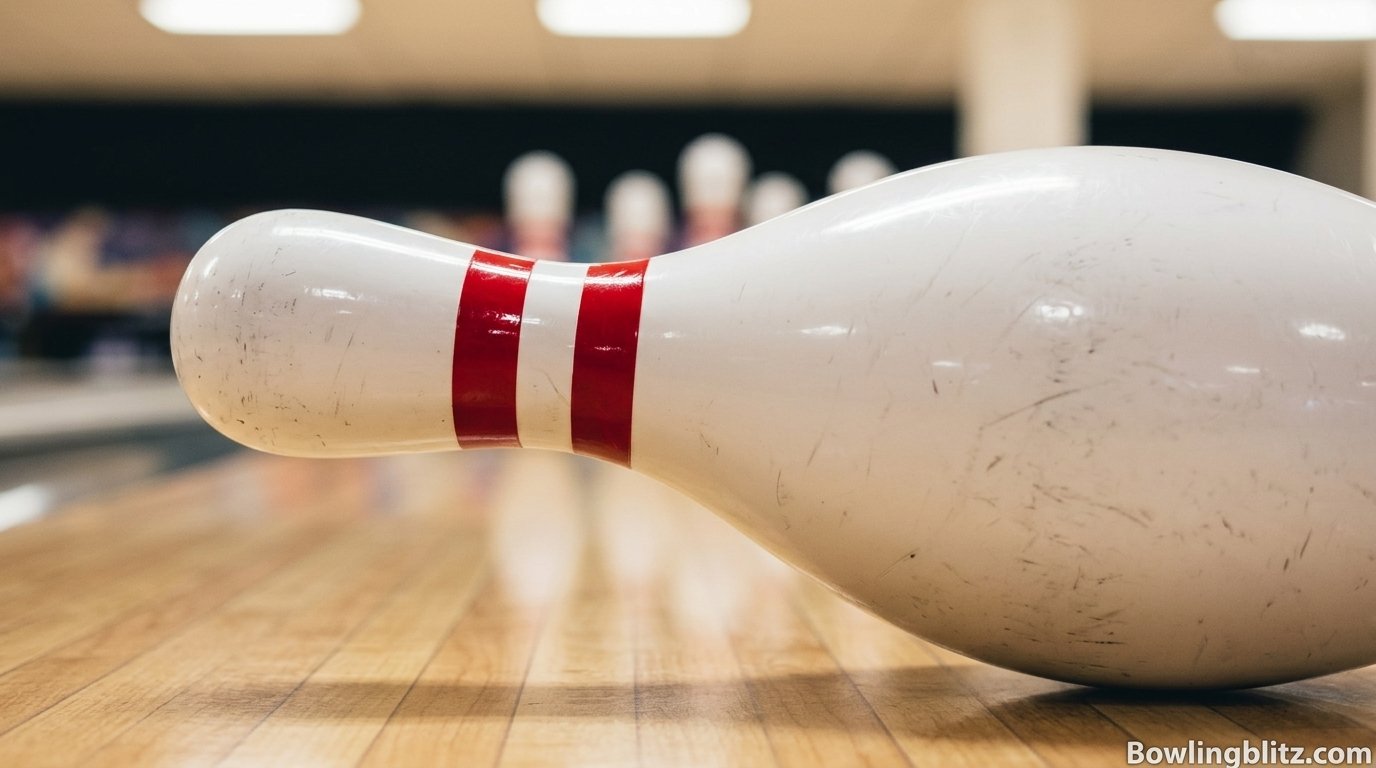
The red stripes are not just decoration. They help you read pin motion and make the pin easy to see from the approach. Underneath, many pins carry a small recess in the base, which helps manufacturers control weight.
Where You Hit the Pin Changes Everything
A ball striking low on the belly pushes the pin mostly sideways, sending it into neighbors. A hit higher near the neck can make the pin pivot and spin, often skipping past its neighbors. A thin hit to one side can make the pin slide away without taking anything with it. These small differences explain why two shots that look similar can leave different pins standing.
- Centered belly contact usually creates the best carry.
- High contact may produce spinning or flying pins.
- Thin edge contact can leave a split.
Watching where the ball meets the pin, rather than only counting what falls, is one of the quickest ways to improve your reading of the lane.
Reading the Stripes and the Neck
The red neck stripes may look decorative, but they give bowlers a visual reference when pins wobble, spin or slide. If a pin is struck high, the stripes make the rotation obvious, which helps you understand why the pin flew the way it did. The neck is also the thinnest part, so it is the point where a pin tends to snap into motion when hit.
Why the Base Is Flat
The flat base is what allows pins to sit stable on the pin deck and also what lets them skid or slide across the deck once knocked over. A tiny change in base shape or surface finish can affect how easily a pin slides, which is one reason worn pins behave differently from fresh ones.
- Head: small and light, with little effect on action.
- Neck: thin, with stripes that show rotation.
- Belly: the main striking surface.
- Base: flat, stable and built to slide.
Pin Numbering and Names
Pins are numbered 1 through 10, starting with the head pin at the front. Rows run from the front, with one pin, then two, three and four pins, forming a triangle.
| Row | Pins |
|---|---|
| Front | 1 (head pin) |
| Second | 2 and 3 |
| Third | 4, 5 (center) and 6 |
| Back | 7, 8, 9 and 10 |
The 7 and 10 pins in the back corners are the hardest to convert as spares, and the 5 pin sits dead center behind the 1. Knowing the layout helps you choose your target. For spare shooting, a plastic ball is a great tool, and our roundup of the best spare bowling balls shows why.
Common Leaves and Their Nicknames
Bowlers use the numbers as shorthand for what is left after the first ball. Some well-known patterns appear again and again:
- The 7-10 split: the two back corner pins, famously difficult to convert.
- The 4-6-7-10 “big four”: a notoriously tough leave.
- The 5 pin: the center pin, often called the kingpin.
- The 1-pin “bucket” leaves: several pins in a diamond shape that spare shooters learn to read quickly.
Learning these names makes lane talk easier and helps you decide which angle to use. Corner pins like the 10 are usually approached from the opposite side of the lane, while center pins call for a straighter line.
Using Pin Numbers to Plan Your Spare
Once you know the numbers, you can build a simple plan for every leave. Right-handed bowlers commonly move left to shoot at pins on the right side and move right for pins on the left, because the angle across the lane gives the ball a better path. For the 10 pin, many players start from the far left of the approach and aim diagonally. For the 7 pin, the reverse works well.
Reading Leaves After a Strike Attempt
When the 5 pin remains alone it can look easy, but it sits deep in the rack and often needs a firm, centered hit. When the 8 and 9 pins both remain on opposite sides, you may need a precise angle to clip one and push it into the other. Studying leaves like these during practice makes league nights far smoother.
Pin Spacing and Setup on the Lane
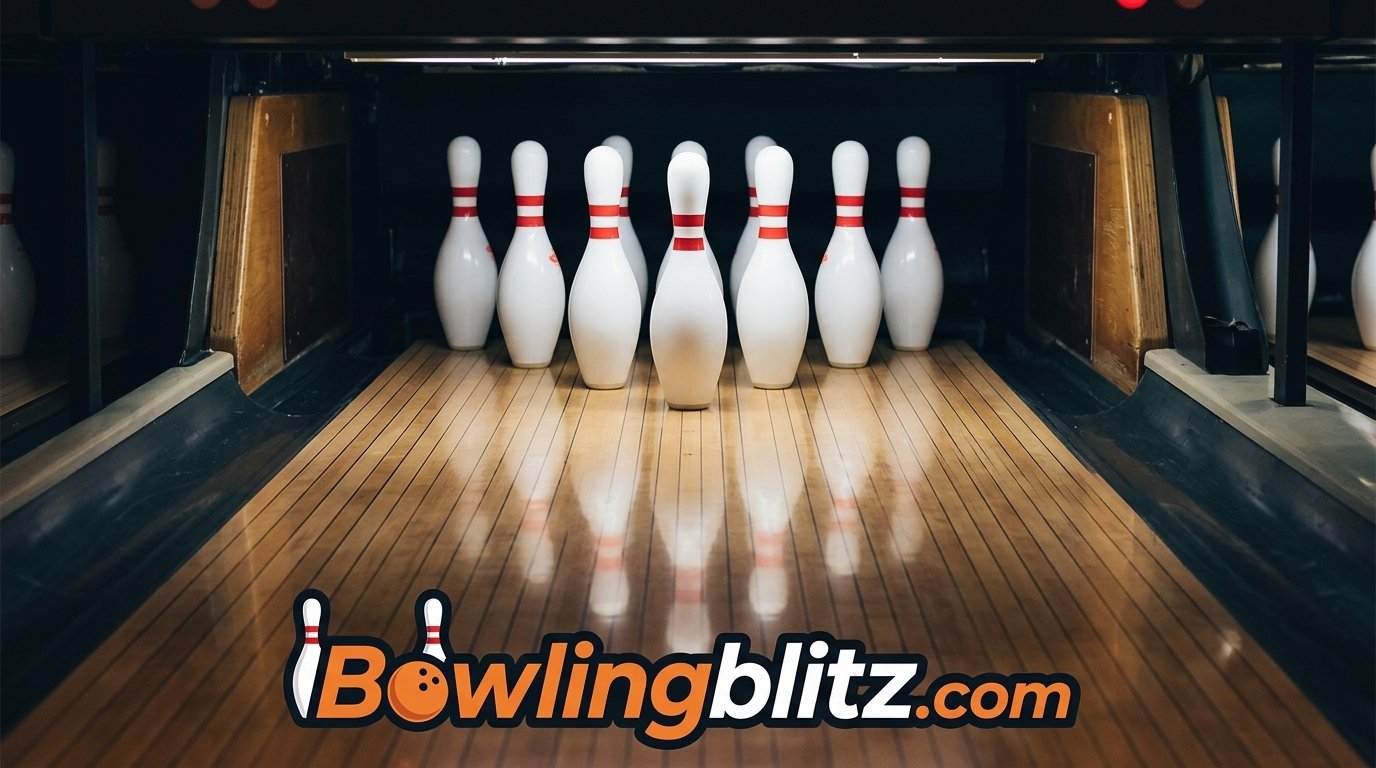
The pins are placed in a triangle on the pin deck, with 12 inches measured from the center of one pin to the center of the next. Because the pin belly is wider than the gap between bases, pins are close enough that a falling pin can reach a neighbor. That is the whole mechanism behind a strike.
The head pin stands exactly 60 feet from the foul line. Most centers use an automatic pinsetter, which sweeps the deck, picks up standing pins after the first ball and resets all ten after the second. Under the hood, the machine uses a rack to hold pins in position while a table lowers them onto the spot marks.
From Pinboys to Pinsetters
Before machines took over, human pinspotters reset pins by hand after every roll. Automatic pinsetters replaced that job and made modern speed and consistency possible. After each roll, the machine lifts standing pins, sweeps the deck clean of fallen ones and then lowers the survivors back into their original spots, or sets a fresh rack of ten for a new frame.
The Pin Deck
Small spot markings on the deck show where each base belongs. A lane is roughly 41.5 inches wide, so the pin triangle takes up only a modest part of the width. The remainder is gutter and approach, which is why even a strong shot can miss entirely when the angle is off.
When a pin sits slightly off its spot, the machine usually resets it, but the occasional awkward reset is part of bowling’s charm.
Pin Versus Ball: Why the Gap Matters
A ball is up to 8.5 inches in diameter and weighs as much as 16 pounds, while a pin is 15 inches tall and about 3.5 pounds. The ball drives through the pins by transferring momentum. A well-placed hit in the pocket, between the 1 and 3 pins for a right-hander, sends the head pin into the 2 and the 3 into the 6 and 10 in a chain reaction.
That reaction depends on entry angle and speed, not just weight. A ball that hooks into the pocket makes a bigger effective target and a better angle, so the right ball counts. If you are shopping, start with the best bowling balls for beginners, and if you are curious about budgets, see how much a bowling ball costs.
Entry Angle: The Hidden Variable
Many coaches point to an entry angle of around six degrees as helpful for strikes. A ball traveling straight at the pocket has less room for error, while one that hooks into it enters at an angle that spreads pin motion more efficiently. This is why a hooking ball often produces more strikes than a straight one, even with equal weight and speed.
Speed, Rotation and Pin Carry
Speed delivers energy, and rotation helps the ball keep its line through the pins. Too slow and the ball deflects. Too fast and it may skid and rebound. A ball also loses some energy to friction, so the best shots balance all three.
Many bowlers also improve scoring simply by choosing a ball matched to their style, which is where tools such as ball reaction and core design come in.
Other Types of Bowling Pins
Ten-pin is the most common game, but it is not the only one. Different formats use shorter or thinner pins and smaller balls.
| Game | Pin Style | Ball |
|---|---|---|
| Ten-pin | Tall, 15 inches, hourglass shape | Large with finger holes |
| Duckpin | Short and squat, under 10 inches | Small, no finger holes |
| Candlepin | Tall and thin, straight sides | Small, no finger holes |
| Five-pin | Smaller than ten-pin, rubber-banded in some versions | Small, no finger holes |
Each variation changes the strategy. In candlepin and duckpin, fallen pins stay in play, so deadwood is part of the game, while in ten-pin the sweep clears the deck.
Scoring Differences
Most of these smaller games give three rolls per frame rather than two, which changes scoring and strategy. In some five-pin formats, pins carry different point values depending on position, so a bowler may aim for specific pins rather than simply knocking down as many as possible. Candlepin is known for the way fallen pins can remain on the deck and be used as part of the next roll.
Pros and Cons of the Smaller Formats
Advantages
- Lighter, easier for kids
- Fun, social and easy to learn
- Regional tradition
Drawbacks
- Fewer centers offer them
- Strikes are harder to come by
- Equipment is less widely sold
Which Pin Style Suits You?
If you want the full, traditional experience with a heavy ball and big pin action, ten-pin is the obvious choice. If you are introducing young children or older family members who struggle with heavy equipment, the smaller formats can be far more comfortable. Regional favorites such as candlepin in parts of New England or five-pin in Canada also offer a taste of local bowling culture that you will not find elsewhere.
Can You Mix Equipment?
Generally not. Each format has its own lane dimensions, pinsetter, ball size and rules, so a ten-pin ball will not work on a duckpin lane, and the reverse is also true. Always check which game a center offers before you pack your bag.
- Call ahead to confirm the format, especially when traveling.
- Rent equipment first if you have never tried the game.
- Learn the local scoring rules, since they can differ from ten-pin.
Pin Action, Carry and Scoring
Pin action describes how pins move after contact: how they tumble, bounce off the back cushion and knock down others. Good pin action turns an average hit into a strike. Bad action leaves splits. Several variables influence it, including ball speed, rotation, entry angle, pin weight and lane oil.
Scoring is simple on paper. A strike knocks down all ten pins on the first ball and earns ten plus the next two rolls. A spare clears the rest with the second ball and earns ten plus the next roll. An open frame scores only the pins knocked down. A perfect game is twelve strikes in a row, for 300.
Strike tips
- Aim for the pocket
- Match ball to lane
- Keep a repeatable release
Common mistakes
- Hitting the head pin flat
- Wrong ball weight
- Ignoring shoe slide
Footwear affects your slide and balance, which is why bowling shoes are different from regular sneakers.
Understanding Splits and Spares
A split occurs when the head pin falls but two or more standing pins are separated by a gap. Some splits, like the 7-10, are famously difficult, while others are much more makeable. The key is to choose a target that sends your ball into one pin and uses it to take out another.
Practical Tips for Better Pin Carry
- Aim for the pocket, not the head pin.
- Keep your speed steady rather than muscling the ball.
- Use a plastic spare ball for single-pin leaves so your line stays straight.
- Pay attention to how pins react on different lanes, because oil patterns change carry.
- Practice common spare angles until they feel automatic.
Consistent spare shooting often adds more to your average than one or two extra strikes, because it protects you from open frames.
How Scoring Works, Step by Step
A game has ten frames, and each frame gives you up to two rolls. Knocking down all ten pins is the goal, and what you earn depends on how quickly you do it.
| Result | What It Means | Frame Score |
|---|---|---|
| Strike (X) | All ten pins on the first ball | 10 plus the next two rolls |
| Spare (/) | All ten pins in two balls | 10 plus the next roll |
| Open frame | Pins left standing after two balls | Only the pins knocked down |
Here is a simple example. Say you throw a strike in the first frame, then 7 and 2 in the second. The strike scores 10 plus 7 plus 2, or 19. The second frame scores 9, for a running total of 28. A spare works the same way but looks only one roll ahead. If you spare in the third frame and then knock down 8 pins on your next ball, that frame is worth 18.
The Tenth Frame
The final frame is special. If you roll a strike or spare, you earn bonus balls so the frame can be scored fully: two extra balls after a strike, one after a spare. That is why a perfect game takes twelve strikes in a row, with nine in the first nine frames and three in the tenth, for 300.
Scoring Tips for Beginners
- Count each strike as a promise, since its value depends on future rolls.
- Do not worry if the scoreboard seems slow to update. It waits for your bonus balls.
- Focus on spares first, because converting them protects your score more reliably than chasing strikes.
- Learn your target pin for each leave so your second ball has a clear purpose.
Pin Care, Wear and Replacement
Pins live a hard life. Bowling centers rotate pin sets regularly. Signs a pin is worn out include chipped coating, visible cracks, flat spots on the belly, or a noticeable change in weight or balance. Many centers refinish pins by recoating them before retiring them.
- Wipe pins with a soft, lightly damp cloth, not harsh solvents.
- Store them upright in a cool, dry place.
- Avoid dropping them on hard edges, since the coating can crack.
- Replace the full set if several pins show wear, so action stays consistent.
How Centers Maintain Pins
Bowling centers regularly inspect pins for cracks, loose coating and worn necks. Pins are rotated between lanes so that no single set takes more punishment than the others. Many are returned to the maker for recoating, which extends their life and keeps weight in range.
If You Own a Pin at Home
Check the base and neck for cracks before using it as furniture. If the coating is breached, moisture can reach the wood, so seal damaged areas. Avoid harsh chemicals, store pins away from heat sources, and place them on a stable surface so they cannot be knocked over onto a child or pet.
- Inspect for hairline cracks around the neck.
- Clean with mild soap and water, then dry.
- Do not leave pins in direct sun for long periods.
When to Retire a Pin
A pin that has lost its stripe paint, has large chips, or wobbles on the deck is ready for retirement or refinishing. Pins that feel noticeably lighter may have lost wood from the core through damage, and pins that sound dull when tapped may have internal cracks. Centers often retire pins in groups so lane behavior stays uniform.
Refinishing Versus Replacing
Refinishing is cheaper and more sustainable, but it only works if the core is still sound. If the wood has split, replacement is the safer option. For home collectors, a refinished pin can look nearly new and still carry the vintage character of the original.
Refinish when
- The coating is scuffed
- The core is solid
- The pin is vintage
Replace when
- The wood is cracked
- Weight has changed
- It wobbles badly
Home Use, Decor and Collector Pins
Retired pins have a second life. Fans turn them into lamps, bar stools, mailboxes and wall displays. Vintage pins with old logos or faded stripes are popular with collectors, and signed or event pins can carry real value. If you want a real pin for your game room, buy from a bowling center that is replacing stock, or from a reputable seller. Wondering where else to shop for gear? See where to buy bowling balls.
| Use | Best Pin Choice |
|---|---|
| Decor | Used or vintage full-size pin |
| Kids’ play | Lightweight plastic set |
| Practice | Regulation-size pins |
| Gifts | Mini or engraved pins |
Creative Projects
People turn bowling pins into lamps, coat racks, garden ornaments, wine holders, and even Halloween decorations. Because pins are tall, narrow and sturdy, they work especially well as stands and bases. Painting them in team colors or covering them with decoupage makes them personal gifts.
Buying Checklist
- Confirm it is a full-size regulation pin if you want an authentic one.
- Look for chips, cracks or a worn finish.
- Ask about its origin, since league or event pins can add character.
- Factor in shipping, because pins are bulky and awkward to pack.
Whether it ends up as a keepsake or a working part of your home bowling lane, a real pin is a satisfying object to own.
Making a Bowling Pin Lamp
A pin lamp is a popular beginner project. You need a pin, a lamp kit, a drill with a long bit and a steady hand. Drill carefully through the center, thread the cord through, fit the socket on top and add a shade. Always use a bulb with the correct wattage so the wood does not overheat, and finish the project by sanding any rough spots.
Display Ideas
For a game room, line several pins on a shelf or paint them in team colors. For a bar area, a pin can serve as a bottle holder. For a child’s room, a mini pin set makes a playful toy and decor item in one.
Safety Notes
- Secure tall pins so they cannot tip over.
- Keep pins away from direct heat.
- Use proper tools and eye protection when drilling.
A Closer Look at Buying Collector Pins
Collecting pins can be a fun and affordable hobby, but condition and authenticity change a pin’s appeal. A common pin from a local center may be easy to find, while a limited, signed or event-specific pin can be much harder to track down. Take time to compare several listings before you commit.
| What to Check | Why It Matters |
|---|---|
| Condition of the coating | Chips and cracks affect display value and safety |
| Markings and logos | Original branding can add character and interest |
| Size and shape | Confirms it is a regulation ten-pin and not a novelty copy |
| Provenance | A known history or signature can raise collector appeal |
| Shipping method | Pins are bulky, so good packing prevents damage |
Where to Look
Bowling centers that are renovating or closing sometimes sell off pins. Local classifieds, estate sales, flea markets and online marketplaces are other options. Ask sellers for clear photos of the base, neck and any markings, and request a measurement of the height if the listing is unclear.
Display and Storage
Once you own a pin, keep it out of direct sunlight, which can fade stripes and yellow the coating. Use a stable stand or shelf, wipe it gently with a soft cloth, and avoid damp areas. If you collect more than one, group them by era or center for a tidy display, and keep a simple note of where each came from.
Frequently Asked Questions
How tall is a bowling pin?
A standard ten-pin bowling pin stands 15 inches tall. That height has been held constant so a pin at one center behaves the same as at another. Its slim profile means most of its mass sits in the belly, which affects how it tips and how it reacts when struck.
How much does a bowling pin weigh?
A regulation ten-pin weighs between 3 pounds 6 ounces and 3 pounds 10 ounces. Compared with a ball that can reach 16 pounds, a pin is light. Pins in a set are matched closely so that none behaves very differently from the rest.
How wide is a bowling pin?
The belly, which is the widest point, measures about 4.75 inches. The base is much narrower at roughly 2.25 inches, and the neck is slimmer still. This shape lets a pin tip with a fairly modest push while still giving the ball a good target.
What are bowling pins made of?
Traditional pins use a hard maple wood core covered in a tough plastic coating. Some modern pins use a synthetic core. The coating protects against chips and scuffs, gives the pin its glossy white finish and holds the red neck stripes in place.
How far apart are bowling pins?
Pins are placed 12 inches apart, measured from the center of one pin to the center of the next. Because the belly is wider than the gap between bases, a falling pin can reach and knock over its neighbors, which is how strikes happen.
How far is the head pin from the foul line?
The head pin stands 60 feet from the foul line. That distance is part of why lane length and ball speed matter, since the ball needs to reach the pocket with the right line and enough energy to carry through the rack.
Which pin is the head pin?
The head pin is the 1 pin, standing alone at the front of the triangle. It is the pin most players aim near, though the ideal target is usually the pocket just beside it, between the 1 and 3 pins for a right-handed bowler.
Why are there red stripes on bowling pins?
The two red stripes around the neck are partly traditional and partly practical. They make pins easier to see and help bowlers watch how a pin rotates and moves after being hit, which makes it easier to understand how a leave occurred.
What is the hardest pin to hit?
Many bowlers struggle most with the 7 and 10 pins in the back corners, especially when they are left as a 7-10 split. Corner pins sit farther from the center line and require a precise angle, which is why practicing spare shooting pays off.
Are all bowling pins the same size?
No. Ten-pin uses the 15 inch pin described here, but duckpin, candlepin and five-pin use different shapes and sizes, along with smaller balls. Always check which format a center offers before you pack equipment.
How heavy is a bowling ball compared with a pin?
A ball can weigh up to 16 pounds, which is more than four times the weight of a single pin. That difference lets the ball keep much of its momentum while it knocks down multiple pins, as long as the shot reaches the pocket correctly.
Can I buy a real bowling pin for home?
Yes. Many bowling centers sell retired pins, and online sellers and collectors offer both used and new ones. Check the condition, confirm the pin is full size if you want an authentic one, and ask about shipping, since pins are bulky.
Conclusion
A bowling pin looks simple, but the details are precise: 15 inches tall, about 4.75 inches at the belly, roughly 3.5 pounds, spaced 12 inches apart in a numbered triangle sixty feet from the foul line. Understanding those facts helps you read pin action, choose better targets and appreciate why the same shot can produce very different results. Pair that knowledge with the right ball, shoes and a repeatable approach, and your scores will follow.
As a quick recap, remember the headline numbers: 15 inches tall, about 3.5 pounds, 12 inches between pin centers and 60 feet from the foul line. Remember too that the pin is only half of the picture. The right ball, a smooth slide and a repeatable release do the rest. Whether you are a beginner learning the lane or a veteran chasing a higher average, these facts give you a clearer sense of what is happening every time the ball meets the rack. Take them with you to your next game and see how much more you notice.